
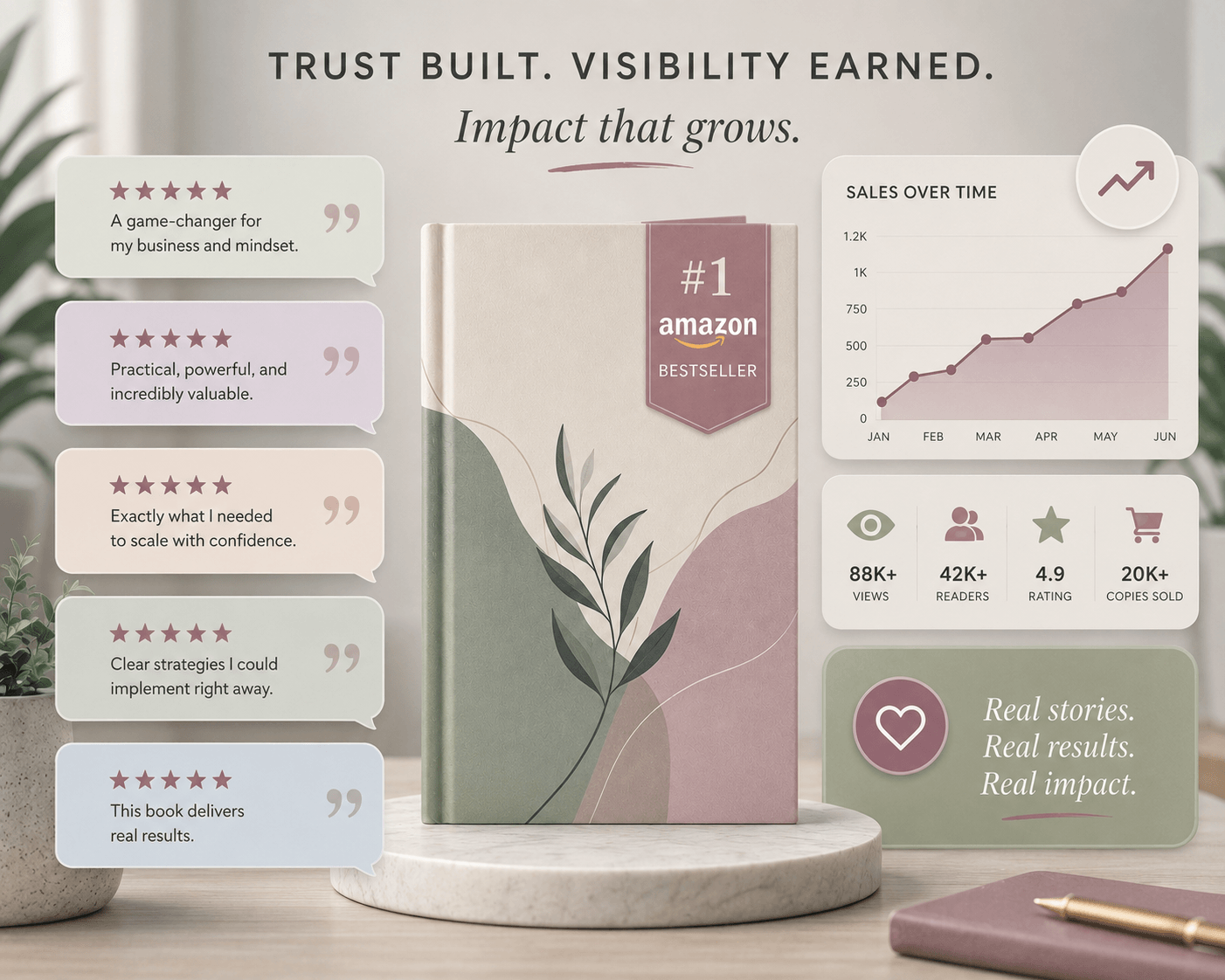

Why Amazon Reviews Matter More Than Book Sales?
If you’re measuring the success of your book by sales alone, you’re focusing on the wrong metric. While selling books is important, Amazon reviews—especially verified reviews—have a much greater influence on discoverability, credibility, Amazon’s recommendation algorithm, and ultimately your ability to attract clients, speaking engagements, and business opportunities.
Most New Authors Chase Sales Instead of Trust
When authors launch their first book, the natural instinct is to concentrate on selling as many copies as possible.
After all, bestseller rankings are exciting.
Watching sales increase feels like tangible proof that your book is succeeding.
But experienced business authors understand something that many first-time authors overlook:
Book sales create momentum. Reviews create long-term authority.
A spike in sales might last a day.
Strong reviews continue influencing buying decisions for months or even years.
Every potential reader who lands on your Amazon page asks essentially the same question:
“Can I trust this book?”
Your reviews answer that question before they ever click the Buy button.
Amazon’s Algorithm Rewards Social Proof
Amazon’s marketplace exists to help customers find products they’ll enjoy purchasing.
To accomplish that, Amazon evaluates numerous signals that indicate customer satisfaction.
One of the strongest signals is verified customer reviews.
Positive reviews tell Amazon that readers found value in the book.
As confidence grows, Amazon becomes more willing to recommend the book through:
- Search results
- Recommended products
- “Customers also bought”
- Category rankings
- Personalized recommendations
Although Amazon’s algorithm considers many factors, verified reviews consistently reinforce credibility and improve discoverability over time.
Why Verified Reviews Matter Even More
Not every review carries the same weight.
A verified review comes from someone who purchased the book through Amazon.
That purchase creates additional confidence for both readers and Amazon itself.
During BSP University training, authors are encouraged to prioritize obtaining Amazon verified reviews early in their launch because those reviews contribute to stronger visibility while also increasing reader confidence. The emphasis is not simply collecting reviews—but collecting reviews from legitimate purchasers through Amazon itself.
The Soft Launch Exists Primarily to Build Reviews
Many authors assume the purpose of an introductory launch is immediate revenue.
The BSP launch strategy takes a different approach.
Instead of maximizing profit during the first few days, authors temporarily reduce the Kindle price—often to just $0.99—to encourage as many readers as possible to purchase the book and leave verified reviews.
This lower introductory price isn’t intended to increase short-term income.
It’s designed to generate the social proof that will strengthen every future marketing effort.
The training recommends communicating openly with your audience, explaining that the promotional price is temporary and asking readers to support the launch by leaving an honest review after reading the book.
Why Twenty Reviews Can Be More Valuable Than Two Hundred Sales
Imagine two newly published books.
Book A sells 200 copies but receives almost no reviews.
Book B sells only 75 copies but earns 25 thoughtful five-star verified reviews.
Which appears more trustworthy?
Which gives future buyers greater confidence?
Which is more likely to persuade someone comparing multiple books on the same topic?
In most cases, readers naturally gravitate toward the book with stronger social proof.
Reviews reduce uncertainty.
They provide reassurance that other people invested time and money—and were glad they did.
Reviews Influence More Than Readers
Many authors think reviews only affect retail customers.
In reality, they influence nearly everyone evaluating your expertise.
Potential clients often check your Amazon page.
Podcast hosts do the same.
Conference organizers frequently research prospective speakers before extending invitations.
Media producers routinely evaluate public credibility.
When they discover dozens of authentic positive reviews, those reviews reinforce your authority before any direct conversation begins.
Instead of simply claiming expertise, your readers have validated it publicly.
Removing the Biggest Barrier to Reviews
One challenge every author encounters is that even enthusiastic readers often postpone leaving reviews.
The BSP training addresses this by removing unnecessary friction.
Rather than expecting every reader to finish a lengthy book before responding, authors are encouraged to ask readers to review the sections that impacted them most.
If someone found value in only two or three chapters, that’s enough to leave an honest review.
This approach increases participation while remaining authentic because readers comment only on material they’ve actually experienced.
Reviews Become Marketing Assets
A great review doesn’t have to remain on Amazon.
With permission where appropriate, positive feedback can reinforce your authority across your broader marketing ecosystem.
Reviews can support:
- Your website
- Speaking proposals
- Social media content
- Email marketing
- Sales presentations
- Media kits
Every review becomes another independent voice supporting your expertise.
Unlike advertising copy, customer reviews carry credibility because they come from readers rather than the author.
The Compound Effect of Reviews Over Time
One of the biggest misconceptions among new authors is believing that reviews only matter during launch week.
In reality, reviews continue working long after your promotional campaign ends.
Every additional review strengthens your book’s credibility for future readers.
Someone discovering your book a year after publication will still evaluate the same signals as someone who found it on launch day:
- How many people have reviewed it?
- What is the average rating?
- Are the reviews detailed and authentic?
- Do readers describe measurable results?
Unlike paid advertising, reviews don’t disappear when your marketing budget ends.
They become permanent social proof that continues influencing purchasing decisions around the clock.
Quality Matters More Than Quantity
While accumulating reviews is valuable, thoughtful reviews create far greater impact than brief comments.
Consider these two examples:
Review A:
“Great book.”
Review B:
“Chapter four completely changed how I approach client onboarding. I implemented the author’s framework within a week and immediately improved my consultation process. Highly recommended for consultants and coaches.”
The second review provides context.
It describes a specific result.
It tells prospective buyers exactly who benefits from reading the book.
Reviews like these don’t simply increase confidence—they actively sell the book on your behalf.
Don’t Buy Reviews—Earn Them
One temptation some authors face is trying to accelerate credibility by purchasing reviews or offering incentives in exchange for positive feedback.
This approach is short-sighted.
Amazon actively monitors review integrity, and violating its review policies can lead to removed reviews, suppressed visibility, or even account penalties.
The better strategy is the one emphasized throughout the BSP training:
- Deliver genuine value.
- Make reviewing easy.
- Ask consistently.
- Focus on honest feedback from real readers.
Authentic reviews build long-term authority because they reflect real reader experiences rather than manufactured popularity.
Reviews Support Every Stage of Your Marketing Funnel
Reviews don’t exist in isolation.
They strengthen every other marketing activity surrounding your book.
For example:
- Advertising performs better when readers see strong reviews.
- Media opportunities become easier because producers can quickly verify public credibility.
- Speaking organizers gain additional confidence before extending invitations.
- Prospective consulting clients perceive less risk when evaluating your expertise.
- Referral partners feel more comfortable recommending your book to others.
In other words, reviews amplify the effectiveness of nearly every marketing effort that follows.
Launch for Reviews First, Revenue Second
Many authors mistakenly optimize their launch around maximizing immediate income.
A more strategic approach is to optimize for long-term authority.
That means viewing launch week as an opportunity to build:
- Verified Amazon reviews
- Reader trust
- Algorithmic visibility
- Category rankings
- Future discoverability
Revenue naturally follows stronger visibility and increased buyer confidence.
Without reviews, however, even an excellent book may struggle to gain traction.
The Real Goal Isn’t Reviews—It’s Credibility
Ultimately, reviews matter because they represent something much larger than star ratings.
They represent trust.
Every positive review tells future readers:
“Someone invested their time and found this book valuable.”
That message carries more persuasive power than almost anything an author can write about their own work.
When dozens of readers independently reinforce your expertise, credibility grows naturally.
That credibility attracts more readers, more opportunities, and ultimately more business.
Conclusion
Book sales create momentum, but Amazon reviews create lasting authority.
Verified reviews improve discoverability, strengthen buyer confidence, support Amazon’s recommendation systems, and influence prospective clients, podcast hosts, media producers, and event organizers alike.
Rather than chasing short-term sales alone, successful authors build launch strategies designed to generate authentic reader feedback that continues working long after launch week has ended.
The most valuable asset on your Amazon page isn’t necessarily your bestseller badge—it’s the collection of genuine reviews that prove readers trust your work.
Build More Than a Bestseller—Build Lasting Authority
A successful book launch isn’t measured only by copies sold. It’s measured by the trust, credibility, and opportunities your book creates long after publication.
Learn how to launch your book strategically so it attracts reviews, authority, and business growth—not just temporary sales.