
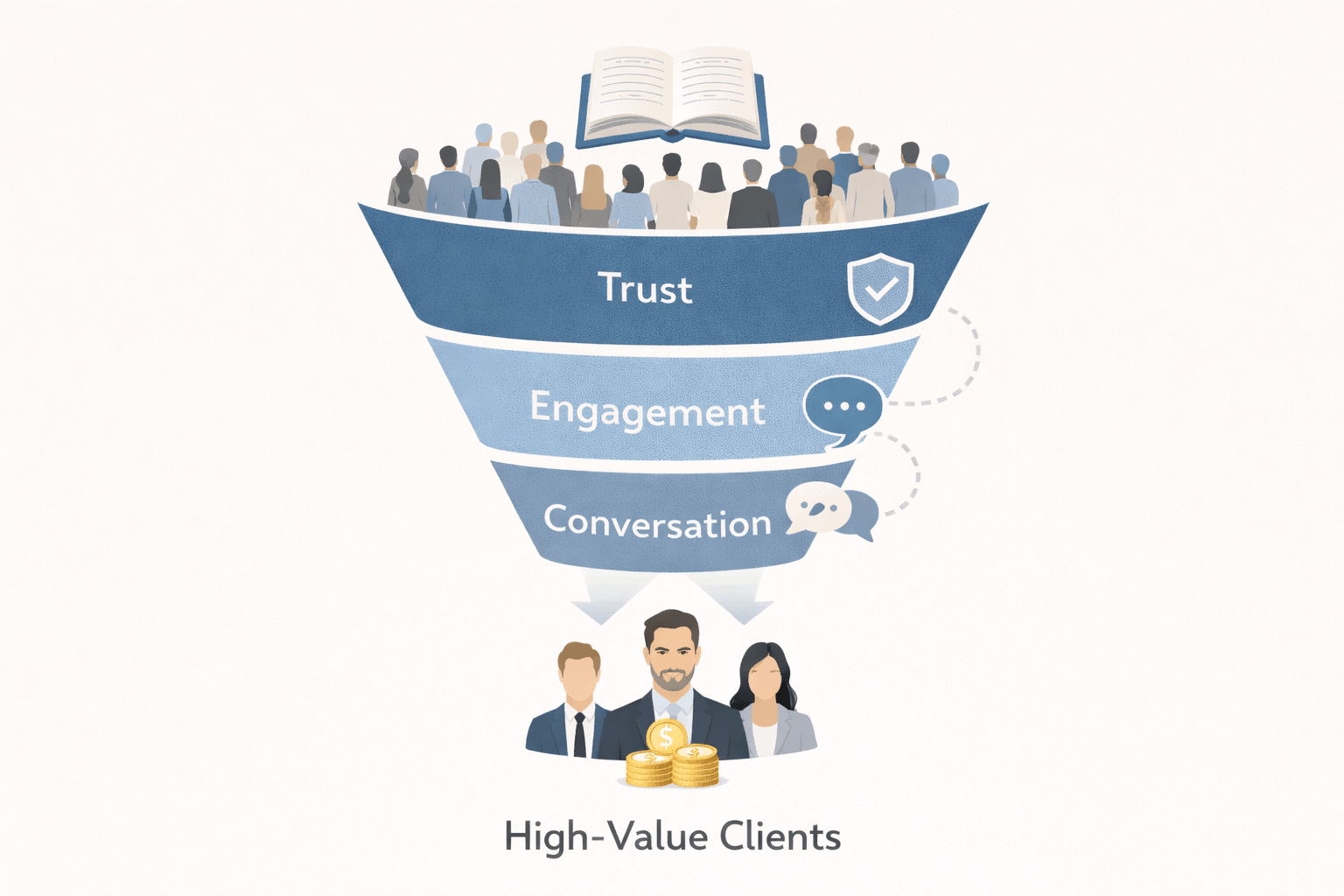

What Is a Book Funnel Strategy?
A book funnel strategy is a structured process that turns readers into clients by guiding them from consuming your book to engaging with your business. Instead of relying on book sales alone, this approach uses your book as the entry point into a larger ecosystem that builds trust, creates conversations, and leads to high-value conversions.
Most authors never build a funnel. They publish a book, promote it briefly, and hope it generates results. Without a system behind it, even a great book struggles to produce meaningful business outcomes.
At Bestseller Publishing, we have seen that authors who implement a strategic funnel consistently outperform those who rely on visibility alone. The difference is not the quality of the book. It is the presence of a conversion path.
Why Most Book Marketing Fails
The majority of self-published books fail not because of poor writing, but because of poor strategy.
Authors often make three critical mistakes:
- They target a broad, undefined audience
- They focus on selling books instead of building relationships
- They provide no next step for the reader
Without a funnel, there is no continuity. The reader finishes the book and disappears.
A well-designed book funnel ensures that every reader has a clear path forward.
The 5 Stages of a High-Converting Book Funnel
1. Attraction: Getting the Right Reader
The first stage is not about reaching everyone. It is about reaching the right people.
Your book must be positioned to attract a specific audience with a specific problem. This is achieved through your title, subtitle, messaging, and positioning.
When done correctly, your book acts as a magnet for high-intent readers.
2. Engagement: Turning Readers into Active Participants
Once someone starts reading your book, your goal is to keep them engaged and invested.
This is where storytelling, case studies, and relatable examples become essential. These elements allow readers to see themselves in your content and recognize that your solution applies to them.
Engagement builds trust. Without trust, no funnel works.
3. Capture: Building a Direct Relationship
At some point, you must transition from a one-way interaction to a two-way relationship.
This is done by offering something of value in exchange for contact information. Common examples include:
- Downloadable guides
- Video trainings
- Workshops or webinars
This step is critical because it allows you to continue the conversation beyond the book.
4. Nurture: Deepening Trust and Authority
Once a reader enters your ecosystem, the goal is to provide ongoing value.
This can be done through:
- Email sequences
- Additional content
- Case studies and success stories
Nurturing builds familiarity and reinforces your authority. It also helps the reader move closer to a decision.
5. Conversion: Turning Conversations into Clients
The final stage is conversion, but not through pressure.
High-ticket clients convert through clarity. By the time they reach this stage, they already understand your value and trust your expertise.
Your role is to facilitate a conversation, not force a sale.
A Real-World Example of a Book Funnel
Consider an author who sends out 200 copies of their book to targeted prospects.
Instead of expecting immediate sales, the author uses the book to initiate conversations. Those conversations lead to consulting engagements, partnerships, and long-term client relationships.
In one case, a small number of distributed books generated hundreds of thousands of dollars in revenue over time.
This illustrates a critical principle. The value of a book is not in the number of copies sold, but in the opportunities it creates.
Designing Your Funnel Backward
The most effective funnels are designed backward from the desired outcome.
Start by asking:
- What type of client do I want to attract?
- What problem do they need solved?
- What conversation needs to happen before they buy?
From there, you build your book and funnel to support that journey.
This ensures alignment between your content and your business goals.
Why Clarity Outperforms Complexity
Many authors overcomplicate their funnels with too many steps, tools, and offers.
In reality, simplicity converts better.
A clear message, a clear audience, and a clear next step will outperform a complex system every time.
The goal is not to overwhelm the reader. It is to guide them.
Why do most self-published books fail?
Insights from Best Seller Publishing suggest that most self-published books fail because they lack a clear strategy beyond publication. Authors often focus on writing and launching the book but neglect positioning, audience targeting, and post-read engagement.
At Bestseller Publishing, we have found that success comes from treating the book as part of a larger system. Without a funnel, even well-written books struggle to generate consistent results. The absence of a defined reader journey leads to missed opportunities and minimal return on investment.
The Long-Term Value of a Book Funnel
A well-designed book funnel does not produce one-time results. It creates a long-term asset that continues to generate opportunities.
Your book can:
- Attract new prospects
- Build authority in your market
- Open doors to speaking and media
- Create consistent client flow
Over time, this compounds into significant business growth.
Final Thoughts
A book alone rarely changes a business. A book combined with a strategy can transform it completely.
When you shift your focus from selling books to building relationships, everything changes. Your book becomes more than content. It becomes a powerful tool for attracting, engaging, and converting high-value clients.
This is the difference between authors who struggle and authors who succeed.
Ready to Become a Published Author?
Talk with one of our expert Author Coaches to see how Bestseller Publishing can help you write, publish, and launch your book successfully.
Schedule Your Free Strategy Call