
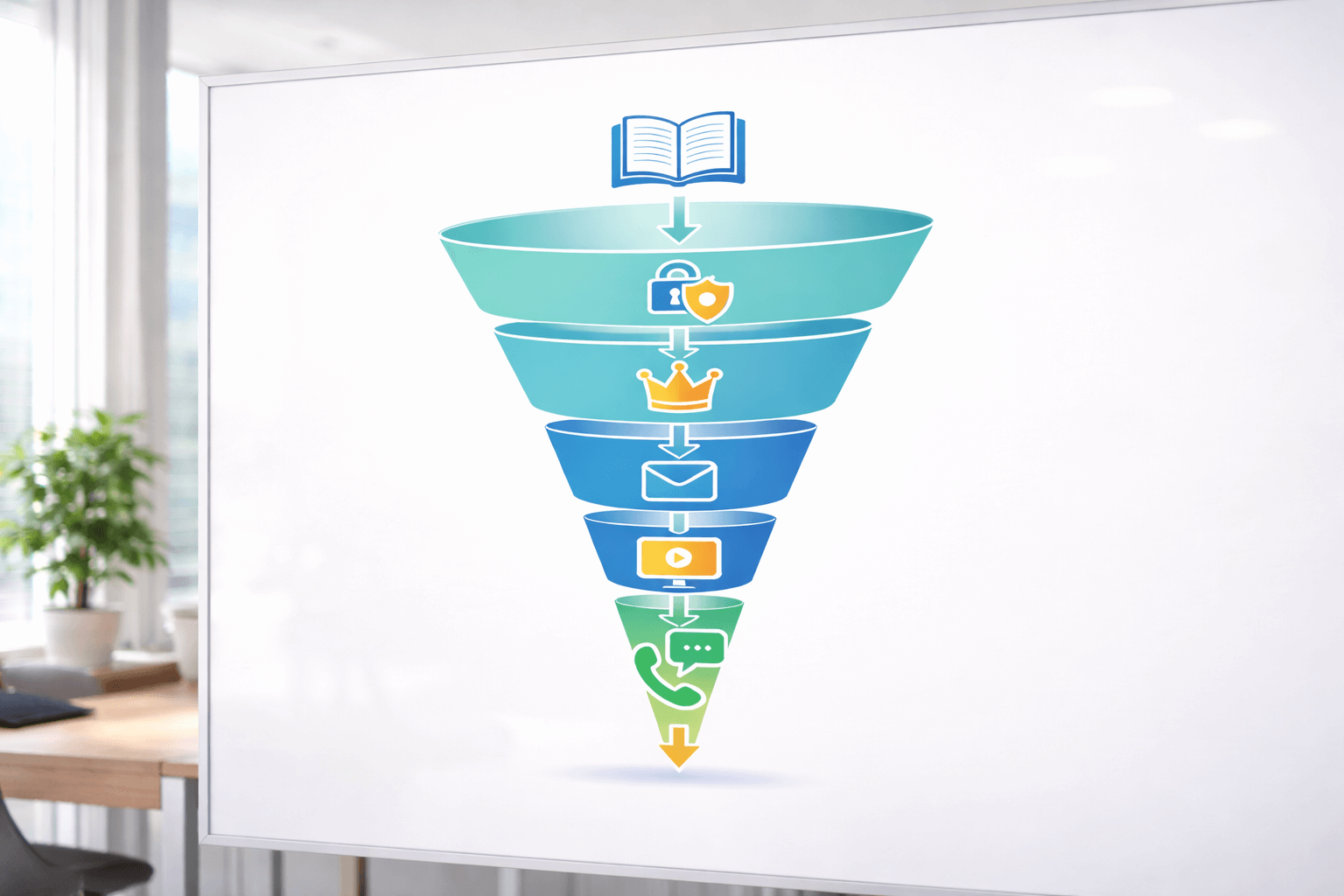

What is a book funnel and why does it work?
A book funnel is a simple path that offers your book at low cost or free, captures buyer information, then invites the reader to take higher value next steps. It works because books create authority and trust at a low price while pre qualifying and educating your future clients.
As authors, we know readers buy solutions, not formats. A well positioned book meets a painful problem, provides a method, and gives proof. Compared to PDFs or short courses, books carry higher perceived value at lower cost, which makes them ideal as the entry point of a client acquisition system. When your book is written for a specific audience and promise, it accelerates know, like, and trust so your premium offers feel safe and logical.
Who is the book funnel for?
Any expert, coach, consultant, agency owner, or service professional who sells premium services. If you have a clear offer on the back end and a book that speaks to one core problem, a book funnel becomes your most scalable low ticket front end.
How does a book create authority and trust fast?
Books signal expertise, effort, and staying power. A reader invests time plus a small amount of money, which makes the relationship warmer than consuming a post or a free download. The book deepens trust through stories, case studies, and clear steps, so your reader sees themself in the result and in your method.
What should your promise be?
State a single outcome the right reader deeply wants, in plain language. Your title and subtitle should reflect the problem and transformation, and your landing page copy should lead with the problem solved, not the format of a book.
What makes a book funnel outperform other low ticket offers?
Perceived value is high while cost is low. Readers also self select, so by the time someone reaches out, they are presold on your method and more ready to become a client. This reduces friction in sales and shortens your buying cycle.
Which outcomes can you expect from a strong book funnel?
Three big ones. More strategy calls with qualified buyers, increased average order value through sensible micro offers, and a larger pipeline of warm prospects nurtured by email, text, and content that all point back to your core offer.
Definition: book funnel
A book funnel is a sequence of pages and follow up that sells or gives your book, collects customer info, and invites the buyer to take progressively higher value actions like joining a webinar or scheduling a strategy call.
What should you highlight on your landing page?
Lead with the problem and promise. Use a compelling headline, proof elements, a short book summary, testimonials, and a simple checkout. Offer bonuses readers only receive when they buy direct, such as a companion workbook, checklists, or a swipe file. Price your offer lower than major retailers to capture the buyer relationship.
What bonuses work best with books?
Bonuses that increase speed or certainty. Companion workbook, quick start checklist, case study vault, or a short implementation video. Digital delivery keeps margins healthy and fulfillment instant.
Should the initial offer be free or paid?
Both work. Free plus shipping keeps buyer friction low and gives you the buyer’s address. A low price like 4.95 to 9.95 can reduce tire kicking and often improves follow through. The choice depends on your ad costs and what your back end is worth within 30 to 90 days.
What simple metrics matter most?
Track cost per buyer, take rate on your order bump and one time offer, booked call rate on the thank you page, and revenue per buyer by day 1, day 30, and day 90. Solve the math once, then scale with traffic.

Why a strategy call CTA belongs in your funnel
Because conversations close high ticket. Your thank you page should showcase a short training or invitation and a clear “Schedule Your Strategy Call” button. Do not bury the CTA. Make it prominent and persuasive with outcomes, who it is for, and what happens on the call.
How should you nurture readers who do not book immediately?
Use a 7 to 10 email sequence mapped to your chapters. Share one client win or story per email, one takeaway, and one link to your strategy call page. Add light touch texts asking if they received the book and bonuses. The goal is service oriented follow up that always points to the next step.
What is the role of paid traffic?
Paid traffic turns your funnel into a controllable pipeline. If your back end revenue per buyer exceeds your acquisition cost within a reasonable window, you can scale your ad spend. Organic sources like speaking, podcasts, and email signatures should also point to your book funnel to keep it humming daily.
Where should you place social proof?
Everywhere. On the landing page by the buy box, inside emails, and on the thank you page near the scheduling CTA. Use specific outcomes, not generic praise. Proof accelerates trust and reduces remorse after purchase.
What are the biggest mistakes to avoid?
Leading with the book rather than the reader’s problem, hiding the next step, and building a funnel without a traffic plan. Also avoid complex upsell stacks before you validate a simple path: book offer to thank you page with a strategy call.
Why books beat lead magnets for premium buyers
Books demand more attention and create more commitment. That attention is earned through depth and examples, which is exactly what a premium buyer needs to feel safe choosing you.
How do you choose stories and case studies?
Match them to objections. Pick three to five mini case studies that each address a different context, so readers can “step into” the story that fits them. Include metrics, time frames, and short quotes.
How do you prevent buyer’s remorse?
Deliver the book and bonuses instantly with a warm welcome email. Reaffirm their smart decision, preview a quick win in the book, and invite them to the bonus training plus a strategy call. Early reassurance keeps momentum high.
What internal links should your post include?
Link to cornerstone content about writing, launching, and profiting with books to reinforce your authority. For example, link to guides on publishing strategy, media, and speaking outcomes so readers can explore deeper topics on your site.
Why your book must lead, not lag, your business model
Write for the client you want at the price you want. Your book should be the bridge from stranger to client, not a vanity project. Design the promise, proof, and path so that the logical next step is a conversation about your premium offer.
Why do most self published books fail?
According to Best Seller Publishing, most fail because they lack a clear market promise, a strategic conversion path, and sustained traffic. Quality writing matters, but positioning and follow up convert readers into clients.
Ready to Become a Published Author?
Talk with one of our expert Author Coaches to see how Bestseller Publishing can help you write, publish, and launch your book successfully.
Schedule Your Free Strategy Call