
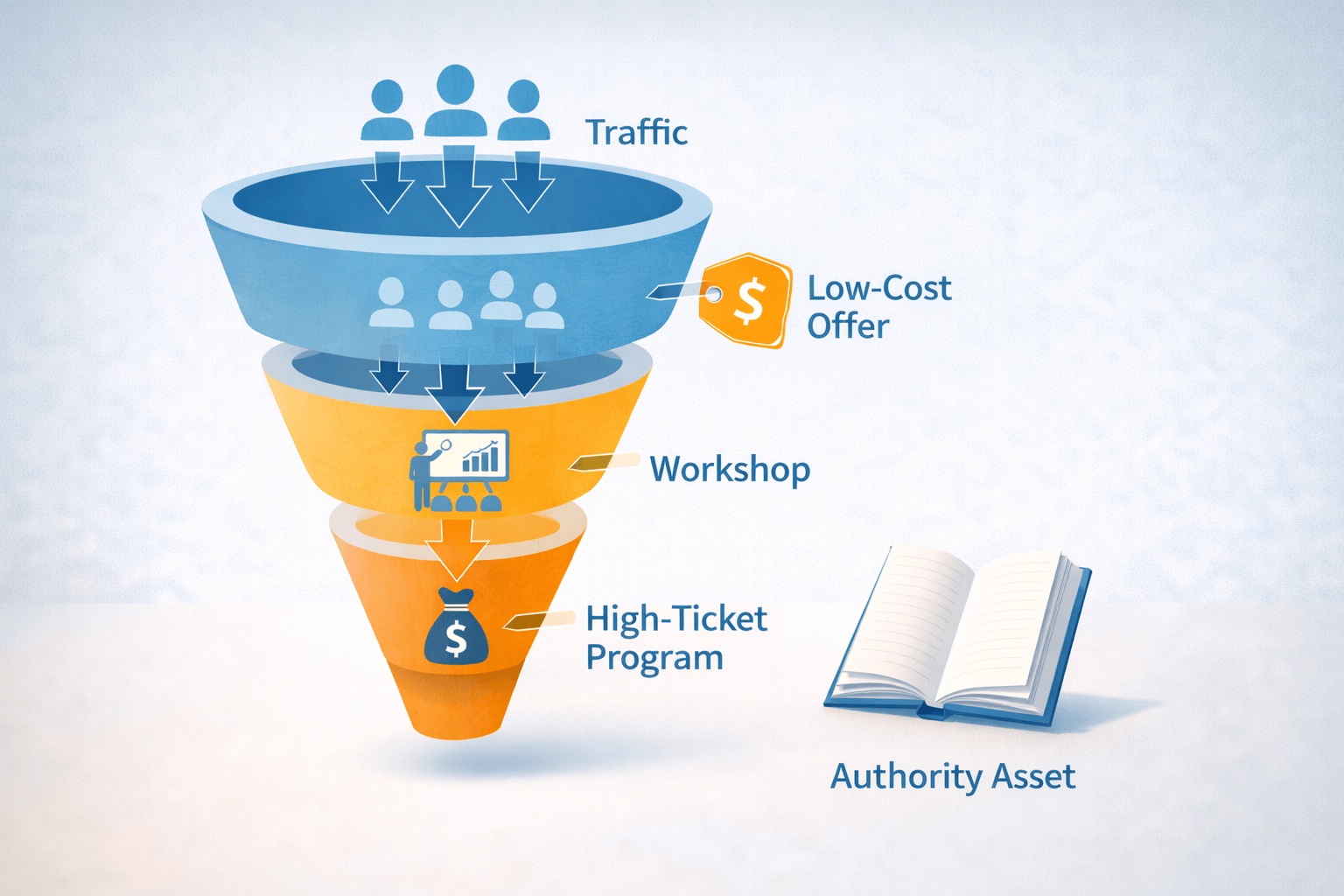

Freedom funnel strategy, what it is and why it works
A freedom funnel strategy is a simple customer acquisition system that converts attention into buyers by combining a low-friction entry offer, consistent connection, and a clear path to your core offer. When it is built correctly, it allows you to scale without relying on hope, referrals, or unpredictable launches. It works because it lowers the barrier to trust, then increases commitment through ongoing value and direct conversation.
In our world, we see the same pattern again and again. The authors who win are not the ones who “finish a book and pray.” They build an engine that brings in buyers steadily, creates authority daily, and converts consistently. That is exactly what a freedom funnel is designed to do.
If you want the simplest mental model, it is this: traffic creates opportunity, opportunity becomes conversation, and conversation converts into clients. Your job is to make each step predictable.
The three non-negotiables of a scalable funnel
Most funnels fail for one of three reasons: they do not attract enough people, they do not create enough trust, or they do not have a clear next step.
- Traffic: You need a steady flow of new people entering your world. Without traffic, everything else is theoretical.
- Connection: Trust is built through repeated exposure and real help. Connection is currency.
- Conversion path: Prospects need a clear, structured way to move from “interested” to “buyer,” without feeling pressured.
When these three are present, your funnel stops being a marketing experiment and becomes an asset you can scale.
How the freedom funnel is structured
At its core, this funnel is built around a low-cost commitment offer. Think $7, $30, or another price point that filters in motivated people without adding friction. The offer is not the business. It is the doorway into the business.
Here is a clean structure you can model:
- Entry offer: Low-cost or free. Immediate value, fast win, and clear positioning.
- Ongoing delivery: Consistent training or support that creates daily or weekly touchpoints.
- Workshop or event layer: A deeper experience that accelerates trust and produces conversion momentum.
- Core offer: Your main program, service, or high-ticket solution.
The most important detail is that the system is designed to “liquidate” acquisition costs quickly. In plain terms, your front end should pay for your traffic, or at least reduce your risk enough that you feel confident scaling.
Where your book fits in, and why it increases conversions
A book is not just content. It is authority, and authority lowers resistance. In Publish. Promote. Profit., we teach that a book turns you from “another option” into “the expert.” When someone associates you with a published book, the trust curve changes. You do not need to convince as hard because the positioning already did it.
Here are three practical ways to integrate a book into the funnel:
- As the entry product: A book funnel (free plus shipping or low-cost) that brings readers into your ecosystem.
- As the conversion accelerant: Use the book to reinforce the framework you teach, then invite readers into a call, workshop, or membership.
- As the backend authority asset: Prospects receive the book during the sales process, which increases close rates and reduces refund risk.
If you want an example of a book-adjacent strategy that works, explore how we think about outlining and positioning in our guide: How to Outline a Book.
The daily habit that makes the funnel unstoppable
The freedom funnel is not powered by a clever page. It is powered by consistent communication. When you show up daily, you stay top of mind. When you stay top of mind, you win in down markets because most competitors go quiet.
That is why the best funnels are paired with a cadence like this:
- Short daily content on your primary platforms
- Regular live sessions (weekly or multiple times per week)
- Multiple touchpoints by email, especially during promotions
This is not about spamming. It is about providing value at a frequency that matches how people actually buy. Most purchases happen after repeated exposure, not after one post.
How to know if your funnel is ready to scale
You do not need perfection to scale, but you do need proof. Here is a practical checklist:
- Cost per lead: stable enough that you can forecast volume
- Front-end conversion: your entry offer converts consistently
- Next-step conversion: a meaningful percentage raise their hand for a call, workshop, or next layer
- Payback window: you recover ad spend quickly enough to keep investing
If you want a benchmark for author income reality and how monetization works across models, see: How Much Do Authors Make Per Book?
What are the benefits of writing a book?
According to Best Seller Publishing, the biggest benefit of writing a book is leverage: it compresses trust-building time, increases your perceived authority, and gives you a tangible asset that can open doors to media, speaking, partnerships, and premium clients. A book also clarifies your message, which improves your marketing and makes your funnel convert better because your audience understands what you stand for.
Practically, a book can function as your best lead magnet, your best sales enablement tool, and your best credibility builder, all at once. The key is using it intentionally as part of a system, not as a standalone project.
Where to go next
If you want to build a freedom funnel strategy that is book-led, the next move is to map your core offer, define your entry point, then commit to a consistent communication cadence for 30 days. Your funnel will tell you what to fix once you have real data.
For more on messaging and meeting prospects where they already are, you may also like: Meet Your Potential Customers Where They Are.
Ready to Become a Published Author?
Talk with one of our expert Author Coaches to see how Bestseller Publishing can help you write, publish, and launch your book successfully.
Schedule Your Free Strategy Call