
How to Get More Clients?
If you want to get more clients, start by creating more opportunities for qualified prospects to raise their hands. That means making more offers—not necessarily asking people to buy, but consistently inviting them to get your book, attend a workshop, start a conversation, request information, or take another logical step toward working with you.
When somebody tells me they’re not generating enough revenue, there are a lot of things I could investigate.
Maybe the offer needs work.
Maybe the sales process needs work.
Maybe the positioning isn’t right.
Maybe they’re talking to the wrong market.
All of those things matter.
But there’s a much more basic question I want to ask first:
How many offers are you actually making?
Because if you’re not making enough offers, you shouldn’t be surprised when you don’t have enough sales conversations.
And if you don’t have enough sales conversations, you shouldn’t be surprised when you don’t have enough clients.
I’ve seen this in my own business. I’ve seen it with authors. I’ve seen it with coaches, consultants, speakers, and experts.
We spend a lot of time worrying about conversion rates while ignoring the fact that there aren’t enough people entering the conversion process in the first place.
Your Sales Problem May Actually Be an Offer Problem
Let’s say you sell a coaching program.
You haven’t enrolled a new client this month.
Your immediate reaction might be:
I need a better closing script.
Maybe.
But how many qualified sales conversations did you have?
Two?
Three?
None?
If you aren’t creating opportunities to talk with qualified prospects, changing your closing script isn’t going to solve the fundamental problem.
The same thing is true if you’re a consultant.
Or a financial advisor.
Or a doctor.
Or an attorney.
Or a speaker.
Or an author trying to use a book to grow a business.
You need people raising their hands.
And before they can raise their hands, they need something to respond to.
That’s the job of the offer.
An Offer Does Not Mean “Buy My Stuff”
This is important because I think a lot of people hear the word offer and immediately imagine some aggressive sales pitch.
That’s not what I mean.
An offer is simply an invitation to take a next step.
You can offer somebody:
- a free copy of your book,
- a paid copy of your book,
- a useful resource,
- a workshop,
- a webinar,
- a case study,
- a consultation,
- a strategy session,
- a conversation,
- a coaching program,
- a consulting engagement,
- or a done-for-you service.
Those are all offers.
They don’t all ask for money.
They ask for a response.
And that’s the distinction I want you to understand.
The first purpose of many offers isn’t to make the sale. It’s to identify the person who is interested enough to take the next step.
Once somebody raises their hand, you have something you didn’t have before.
You have the beginning of a conversation.
The Marketplace Cannot Buy Something It Doesn’t Know Exists
I’ve spent millions of dollars advertising Best Seller Publishing over the years.
And you know what still happens?
New prospects come into our world who have never heard of me.
They’ve never heard of Best Seller Publishing.
They weren’t following me.
They didn’t know what we did.
They simply encountered one of our offers.
Maybe it was an ad.
Maybe it was one of my books.
Maybe it was a workshop.
Maybe it was another piece of marketing.
And suddenly we existed in their world.
That’s a useful reminder for me because no matter how much marketing I do, the market is always bigger than my current audience.
The same is true for you.
There are people right now who have the problem you solve.
Some are actively looking for help.
Some know what kind of solution they need.
Some may even be ready to buy.
But they cannot choose you if they don’t know you exist.
Stop Assuming Your Audience Knows What You Do
This one still drives me crazy.
I’ve had people connected to me on social media who discover something we do at Best Seller Publishing and say:
“Rob, I didn’t know you did that.”
My reaction is basically:
What do I have to do?
But the answer is obvious.
I have to make more offers.
I can’t assume that because somebody follows me, they understand everything my company does.
I can’t assume that because somebody read one of my books, they understand every way we can help them.
I can’t assume that because somebody has been on my email list for a year, they saw the email I sent six months ago.
Neither can you.
Familiarity with your name is not the same thing as understanding your offer.
Why Your Book Is So Valuable Here
This is where authors have an enormous advantage.
You have something you can offer that simultaneously creates value and builds authority:
Your book.
If somebody has the problem your book addresses, offering them the book gives them an easy way to raise their hand.
Think about what they’re really communicating when they say:
“Yes, I’d like a copy.”
They’re not necessarily saying they’re ready to hire you.
But they are giving you useful information.
They’re telling you that your topic matters to them.
They’re telling you that they’re interested enough to learn more.
They’re identifying themselves as somebody who may have the problem you solve.
That’s why I want you to think beyond royalties.
If your only goal is selling copies, that’s one business model.
But if you’re a coach, consultant, entrepreneur, speaker, or professional service provider using a book to attract high-value clients, sometimes giving the book away can be more valuable than selling it.
The immediate transaction isn’t always the point.
The relationship is.
The Book Should Start Conversations, Not End Them
Let’s say you post something useful from your book on social media.
You tell a story.
You teach a principle.
You explain a problem your ideal client is experiencing.
Then you say:
“I go much deeper into this in my book. If you’d like a copy, let me know.”
Now somebody comments.
What happened?
You made an offer.
They raised their hand.
Now you can start a conversation.
Not:
“Great. Here’s my $20,000 coaching program. Where should I send the invoice?”
That’s ridiculous.
Start by being interested in them.
Why did they want the book?
What’s going on in their business?
What are they trying to accomplish?
What problem are they dealing with?
Are they trying to solve it now?
That’s how a book becomes a bridge into a business relationship instead of a product sitting on a shelf.
Not Everybody in Your Market Is Equally Ready to Buy
There’s another piece of this that dramatically changes how I think about offers.
Not everybody in your market has the same level of awareness.
One person may not even realize they have a problem.
Another knows they have a problem but doesn’t know what kind of solution exists.
Another understands the available solutions.
Another knows about the type of product or service you provide.
And another is already looking for somebody like you.
Those people should not all receive the same message.
This concept comes from Eugene Schwartz’s classic framework on market awareness.
I think it’s one of the most useful marketing concepts an expert can understand because it explains why a message that works beautifully with one prospect can completely miss another.
The 5 Levels of Customer Awareness
Let’s break the framework into five practical stages.
1. Unaware
At the bottom is somebody who doesn’t even recognize the problem you solve.
Imagine an expert who gets most of their business through referrals and networking.
They’re losing opportunities because prospects don’t perceive them as the leading authority in their market.
But they haven’t connected those losses to an authority problem yet.
They aren’t thinking about publishing a book.
They aren’t researching authority-building strategies.
They don’t even know they need a solution.
You can reach these people, but it generally requires more education.
2. Problem Aware
Now imagine that same expert loses an important referral.
The prospect chooses a competitor who appears to be better known and more authoritative.
Suddenly the expert realizes:
I have a credibility problem.
That’s progress.
They recognize the pain.
But they may have no idea how to solve it.
3. Solution Aware
Next, they start investigating.
Maybe the answer is social media.
Maybe it’s PR.
Maybe it’s speaking.
Maybe it’s direct mail.
Maybe it’s a book.
They now understand that there are ways to establish greater authority, but they haven’t decided which path makes sense.
This person needs a different conversation than somebody who has never recognized the problem.
4. Product Aware
Now they begin thinking specifically about a book.
Maybe they notice that the competitor winning the business is an author.
They start asking:
Would having a book help me?
Could a book make prospects see me differently?
Could I use a book to become better known in my market?
They’re much closer.
They don’t need to be convinced that authority matters anymore.
They need help deciding whether this particular solution is right for them.
5. Most Aware
At the top are people who already understand the problem and the solution.
They’re in the market.
They may have wanted to write a book for years.
They may already be comparing ways to get it done.
They may simply need the right offer from the right company at the right moment.
Those are very different prospects from the person at stage one.
So, are you ready to take the next step?
Click the button and we will connect you with your personal Author Development Coach. Together, you will come up with a plan for your success as a Best Seller…Guaranteed!
Why Awareness Changes the Offer You Make
Here’s the practical lesson.
If you’re talking to somebody who doesn’t know they have a problem, asking them to immediately buy an expensive solution is a huge leap.
You have education to do first.
But if somebody already knows they have the problem, understands the solution, and is actively looking for help, you don’t need to spend six months pretending they aren’t interested.
Make the offer.
This is why I like thinking about the market in two broad groups.
There are people who need significant education and nurturing.
And there are people much closer to taking action.
You need marketing for both.
But if you need clients now, you should pay very close attention to the people who already understand the problem and are closer to a buying decision.
You Don’t Need Everyone to Respond
This is another mindset shift.
An offer does not have to appeal to your entire audience.
It shouldn’t.
You’re looking for the people for whom the timing, problem, and solution line up.
If you make an offer and ten people raise their hands, you don’t need all ten to buy.
Maybe six discover it’s not right for them.
Maybe two aren’t ready yet.
Maybe two become excellent clients.
That’s fine.
The offer did its job.
It surfaced interested people and created conversations.
The Client-Acquisition Equation I Want You to Remember
You can make marketing extraordinarily complicated.
But underneath all the technology, funnels, algorithms, content, and automation is a very simple progression:
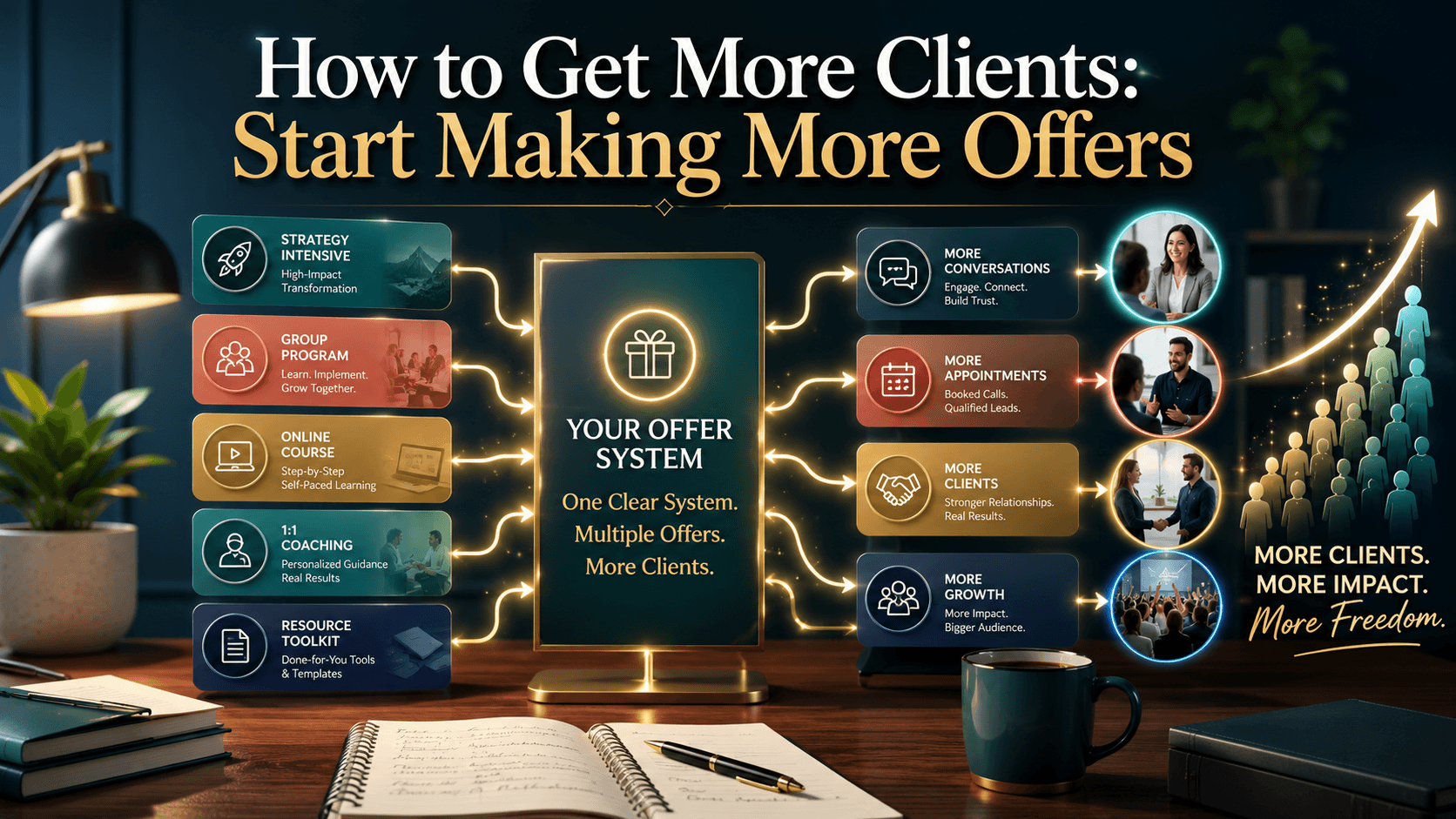
More relevant offers → more people raising their hands → more qualified conversations → more opportunities to make sales.
That doesn’t mean making bad offers more frequently will magically fix your business.
The offer still needs to solve a problem.
The audience still needs to be right.
Your sales process still matters.
Your delivery still matters.
But none of those things eliminate the need to consistently create opportunities.
So before you rebuild your website…
Before you decide you need 100,000 followers…
Before you spend three months designing another funnel…
Ask yourself:
How many meaningful opportunities did I give qualified prospects to raise their hands this week?
If the answer is one—or zero—you may have just discovered the first problem to fix.
And the good news is that you don’t need to wait six months to fix it.
You can start making better offers today.
What Should You Actually Offer?
Once you understand that you need to make offers more consistently, the next question is obvious:
What should I offer?
My answer is usually simpler than people expect.
Offer something your ideal prospect already wants that gets them one step closer to solving their problem.
That could be the complete service you sell.
But it often shouldn’t be.
If somebody is just beginning a relationship with you, asking them to make a major commitment immediately may create unnecessary friction.
Instead, you can create what I think of as a hand-raising offer.
You’re giving an interested prospect an easy way to say:
Yes, I want to know more about that.
Offer #1: Give Them the Book
If you’re an author, this is one of the easiest offers available to you.
Give people the book.
Yes, I said give it to them.
I know some authors immediately react:
But I want to sell my book.
That’s fine if the book sale itself is your business model.
But if the book is designed to attract a client worth thousands or tens of thousands of dollars, I don’t want you protecting a $15 book sale so aggressively that you lose sight of the larger opportunity.
If somebody says they want a book about the exact problem you solve, they have just given you useful information.
They’re raising their hand.
Now the book can start a conversation.
Free Doesn’t Mean Worthless
When I suggest giving away a book, I’m not saying the book has no value.
I’m saying its strategic value may be greater than its retail value.
Think about what happens when the right prospect receives your book.
They’re exposed to your:
- ideas,
- philosophy,
- stories,
- methodology,
- expertise,
- and point of view.
That’s a lot of trust-building wrapped inside one asset.
If that book ultimately contributes to a valuable client relationship, giving away the copy was not a loss.
It was marketing.
Offer #2: Create a Simple Workshop
A workshop is another excellent hand-raising offer because it sits between content and a full client engagement.
You’re not simply saying:
“Here’s something interesting to read.”
You’re inviting the prospect to spend focused time solving a specific problem with you.
Your workshop can be free.
It can also be paid.
The right choice depends on your audience, authority, and objective.
If you’re building a new audience and want more participation, free may remove friction.
If you already have an established audience that values your teaching, a paid workshop can qualify people more aggressively.
Either way, make the promise specific.
Don’t Sell “A Workshop.” Sell the Result of the Workshop.
This is where the wording of your offer matters.
“Join my business workshop” is weak.
Why?
Because the prospect has to figure out why they should care.
A better offer tells them what they will be able to do differently.
For example:
Join me for a live workshop where I’ll show you how to turn your book into a client-acquisition asset without depending entirely on royalties or referrals.
Now I understand the outcome.
Specific offers give people a reason to respond.
The Anatomy of a Strong Hand-Raising Offer
When I’m thinking about a direct offer to people who are already relatively aware of the problem, I want several things to be clear.
Call Out the Right Person
Who is this for?
Don’t force everybody to decide whether they fit.
You might say:
Consultants…
Financial advisors…
Business owners…
Authors…
Coaches…
Specificity helps the right person stop.
Make a Clear Promise
What is the desired result?
The clearer you can make the outcome, the easier it is for the prospect to understand why the offer matters.
Do not manufacture claims you cannot support.
But don’t hide the value either.
Explain Why They Should Believe You
Authority matters.
Why are you qualified to help?
Your book itself can be part of that credibility.
So can experience, relevant outcomes, case studies, credentials, or a demonstrated methodology.
Highlight the Benefits
Show the prospect what changes.
What will they gain?
What will become easier?
What problem are they moving away from?
Give Them One Clear Call to Action
What do they do now?
Comment?
Reply?
Register?
Schedule?
Download?
Do not make an interested prospect decode the next step.
Offer #3: Use Content to Set Up the Offer
You don’t need every social media post to contain a pitch.
I don’t recommend that.
Teach.
Tell stories.
Share something useful.
Challenge assumptions.
Then periodically connect the content to an offer.
For example, teach a principle from your book.
At the end, add:
“If this is something you’re dealing with, I go much deeper into it in my book. Comment ‘book’ and I’ll get you a copy.”
That’s an offer.
The content builds interest.
The offer identifies who wants to go deeper.
You Don’t Need a Huge Audience to Start
People sometimes look at somebody with thousands of followers and assume:
This works for them because they’re already famous.
No.
A larger audience gives you more potential responses, but the fundamental mechanism works with a small audience too.
If you have 300 people who genuinely know you and 10 of them are excellent prospects, you don’t need a million followers to start conversations.
You need to give those 10 people a reason to identify themselves.
A useful offer can do that.
Offer #4: Put Offers Inside Your Email
Email is one of the simplest places to make more offers because you’re already communicating with the audience.
I use what I call a super signature in my emails.
After the normal email and my sign-off, I give readers several ways I can help them.
That might include one of my books.
It might include another resource.
It might include an opportunity to talk with our team about getting their book done.
The main email doesn’t have to be about the offer.
The offer is simply present for the person whose timing is right.
That’s important.
Your Audience Is Reading on Their Timeline, Not Yours
You may send an email today about something completely unrelated to your primary service.
One reader opens it and suddenly notices the offer at the bottom.
Maybe they’ve been thinking about writing a book for six months.
Today is the day they respond.
If I only made that offer twice a year, I would be depending on the prospect’s buying timeline perfectly matching my promotion calendar.
I don’t want to depend on that.
I want the opportunity to be visible consistently.
Offer #5: Invite People to Start a Conversation
Sometimes the offer is simply:
Let’s talk.
This works especially well for complex or high-value services where the prospect needs help determining fit.
You might ask somebody to:
- reply to an email,
- send you a direct message,
- complete an application,
- or schedule a consultation.
There doesn’t need to be a product purchase before the conversation.
The conversation itself can be the offer.
Don’t Turn the First Response Into a Pitch Ambush
This is where people can ruin the entire strategy.
Someone raises their hand.
Then the marketer immediately attacks.
Don’t do that.
If somebody asks for your book, begin by giving them what you promised.
Then be curious.
Why did the book catch their attention?
What are they working on?
How long has this been a problem?
What have they already tried?
Are they looking for help now?
You’re not trying to manipulate somebody into a sales call.
You’re trying to understand whether a legitimate fit exists.
So, are you ready to take the next step?
Click the button and we will connect you with your personal Author Development Coach. Together, you will come up with a plan for your success as a Best Seller…Guaranteed!
Offer #6: Use a Book Funnel
Once you understand that offers work, you can begin automating some of the process.
A book funnel can make an offer continuously without you manually posting it every morning.
Someone sees an ad or promotion.
They purchase or request the book.
They receive bonuses or follow-up.
They encounter another relevant next step.
Eventually, the right people have an opportunity to schedule a conversation or explore your service.
That’s automation doing what you could otherwise do manually.
But notice what automation did not replace.
The offer.
You still needed a reason for somebody to respond.
Automate What Already Makes Sense Manually
People often get excited about funnels before they understand the underlying customer journey.
I would rather you first understand:
Offer → Response → Conversation → Next Step
Then automate pieces of that pathway.
Otherwise, you may build sophisticated technology around an offer nobody wants.
Offer #7: Use Your Book in Networking
Maybe you’re thinking:
Rob, I’m not doing paid ads. I get most of my clients through networking.
Great.
Then use the book in the system that already works for you.
Bring books to the networking event.
Give them to qualified people.
If everybody in the group already has one, give them extra copies for somebody they know.
Ask for introductions to people who would benefit from the subject.
Then follow up.
Don’t abandon a successful acquisition channel because somebody told you that you need a complicated online funnel.
Use your book to amplify what already works.
Your Book Can Supercharge an Existing Client-Acquisition Method
This is a principle I want you to remember.
If you’re already getting clients through:
- networking,
- referrals,
- speaking,
- LinkedIn,
- email,
- podcasts,
- social media,
- or paid advertising,
you do not necessarily need to replace that system.
Ask:
How can I insert my book into this process to create more authority, more responses, and more conversations?
That’s often a much better place to begin.
Make the Offer Specific Enough to Earn Attention
One of the reasons offers fail is that they are too vague.
“Let me know if I can help” is technically an offer.
It is not a very compelling one.
Help with what?
For whom?
To accomplish what?
A stronger offer has edges.
For example:
“I’m opening three spots for consultants who want to turn their expertise into a book that generates authority and qualified client conversations. If you’re interested, reply and I’ll send you the details.”
Now the right person knows:
- who it’s for,
- what the opportunity is,
- why it might matter,
- and what to do next.
The Goal Is More At-Bats
I like using the baseball analogy here.
If you’re never stepping up to the plate, you’re not going to hit many home runs.
Making more relevant offers gives you more at-bats.
More at-bats give you more conversations.
More conversations give you more opportunities to find the right fit.
And more qualified opportunities eventually create more sales.
Not every offer works.
Not every person responds.
Not every response becomes a client.
That’s normal.
The objective is not perfection.
The objective is consistent opportunity creation.
The Offer-Frequency Audit
Here’s what I want you to do.
Look back at the last 30 days.
Count how many times you deliberately invited qualified prospects to take a meaningful next step.
Count:
- book offers,
- workshop invitations,
- webinar invitations,
- consultation offers,
- direct outreach messages,
- email calls to action,
- networking follow-ups,
- and social-media hand-raisers.
Then ask:
Is the amount of opportunity I’m creating consistent with the amount of business I say I want?
That question can be uncomfortable.
It can also be incredibly useful.
Because once you see the gap, you can do something about it.
“`html
Offer #8: Use Direct Outreach on LinkedIn
LinkedIn is one of the places I want you paying attention to if your ideal clients can be identified professionally.
Why?
Because you can find people based on who they are and what they do.
CEOs.
Coaches.
Consultants.
Financial advisors.
Doctors.
Dentists.
Attorneys.
Business owners.
If those people represent your market, LinkedIn gives you a way to identify them and start conversations.
At Best Seller Publishing, we use a team and software to help with this outreach.
The initial message does not need to be complicated.
It can be direct.
For example:
“I’m curious—have you ever thought about publishing a book based on your experience and expertise?”
That’s an offer.
Not an offer to immediately spend tens of thousands of dollars.
An offer to engage around an idea.
If somebody says no, fine.
If they say yes, now we have a reason to continue the conversation.
Don’t Waste Time Hiding What You Want to Talk About
I don’t like pretending I’m connecting with somebody for one reason when I secretly have another agenda.
If I think somebody may be a fit for what we do, I’m comfortable bringing that up.
Respectfully.
Directly.
Without wasting their time.
That doesn’t mean every first message should be a giant sales pitch.
It means the prospect should understand why the conversation exists.
If they’re interested, continue.
If they’re not, leave them alone.
That’s a much healthier way to think about outreach.
The Goal of Outreach Is a Positive Response, Not an Instant Sale
This comes back to the hand-raising idea.
If I reach out to somebody and they respond:
“Yes, I’ve been thinking about writing a book.”
That’s valuable.
I now know something I didn’t know before.
Maybe they’re ready now.
Maybe they’re six months away.
Maybe they need more information.
Maybe they’re not a fit at all.
But now there is a conversation to have.
That’s the objective of many first-step offers.
Use Case Studies and Your Book to Nurture the Conversation
Not every prospect is ready immediately.
That’s okay.
If somebody raises their hand but needs more trust, give them something useful.
Send a case study.
Send the book.
Send an interview.
Send a relevant article.
Show them examples of how you think and the kinds of outcomes your work is designed to create.
Do not assume that “not ready today” means “never.”
Some of the most valuable relationships develop because you stay useful without becoming annoying.
Make Offers Where Your Audience Already Pays Attention
I don’t care whether your primary channel is Facebook, LinkedIn, email, networking, Google, podcasts, or something else.
I care that your ideal clients are there.
If they’re already on your email list, use email.
If they’re active on LinkedIn, use LinkedIn.
If you already speak to associations, use speaking.
If networking is currently how you get clients, use your book at networking events.
If paid advertising already works for you, use paid advertising.
Don’t chase a channel because somebody online said it is the hot tactic this year.
Go where your people are and make offers there.
Do You Need a Community Before You Make Offers?
No.
A community can be incredibly valuable.
If you build an audience that regularly consumes your content, you have people to communicate with whenever you create an offer.
That’s a great asset.
But you do not have to wait until you have thousands of followers before you are allowed to sell something.
When I started using paid advertising, I didn’t need a giant organic community first.
The advertising put the offer in front of new people.
Direct outreach works the same way.
Networking works the same way.
Partnerships work the same way.
The real requirement is not a community.
It’s access to qualified people.
If You Already Have an Audience, Stop Ignoring It
On the other hand, if you’ve been in business for any meaningful amount of time, you probably already have people around you.
You may have:
- email subscribers,
- past clients,
- social followers,
- professional contacts,
- referral partners,
- networking relationships,
- podcast listeners,
- or people who have attended previous events.
Those people already know something about you.
Use that.
You don’t need to build a brand-new audience before you start creating opportunities with the audience you already have.
Manual Offers Come Before Automated Offers
I love automation.
At Best Seller Publishing, we use advertising, funnels, email, outreach systems, and team members to keep offers moving consistently.
But if you’re early in your business, you may not need all of that yet.
You can make the offer manually.
Post it yourself.
Send the email yourself.
Message the prospect yourself.
Bring the book yourself.
Run the workshop yourself.
Learn what people respond to.
Then, when you understand the path, automate the parts that make sense.
Automation Is About Consistency, Not Laziness
The real advantage of automation is that it keeps the system running.
If I know that putting a certain offer in front of the right audience creates qualified conversations at acceptable economics, I want that offer running consistently.
I don’t want my client acquisition to depend on whether I remembered to post something Tuesday morning.
That’s what automation can solve.
It can help you create a predictable rhythm:
Traffic → Offer → Response → Follow-Up → Conversation → Sale
But automation only amplifies what is already there.
If the offer is weak, automation helps you make a weak offer more frequently.
That’s not progress.
Know the Economics Before You Scale
When you’re paying for traffic, I want you thinking about the full value of the customer journey.
You may spend money today and not recover it from the first transaction.
That’s normal in some business models.
Maybe somebody buys a book today.
Then they attend a workshop.
Then they schedule a call.
Then they become a client 30, 60, or 90 days later.
The initial book sale wasn’t the entire economic event.
It was the entry point.
That is why your tracking has to extend beyond immediate revenue.
Frequency Matters More Than Most People Realize
There is a big difference between making an offer and having a system for making offers.
You can post one promotion today.
That’s an offer.
But if you don’t make another one for three months, you still have a consistency problem.
Your prospects are moving through their own lives.
The person who was not ready Monday may be ready six weeks from now.
The person who ignored your email may respond to your next workshop.
The person who didn’t want the digital book may want the physical book.
The person who never responds publicly may answer a private LinkedIn message.
This is why I want multiple ways for people to raise their hands.
You Are Not Making the Same Offer to the Same Person Forever
Offer frequency does not mean hammering your audience with the same message every day.
You can vary:
- the problem you discuss,
- the content surrounding the offer,
- the entry point,
- the format,
- the call to action,
- and the level of commitment.
One week you might offer the book.
Another week you might invite people to a webinar.
Another time you may open a few consultation slots.
Your email signature can quietly keep several offers visible in the background.
Your LinkedIn outreach can run consistently while you’re creating organic content elsewhere.
Those channels work together.
Content and Offers Need Each Other
Content without offers can create an audience that never knows how to work with you.
Offers without useful content can make the relationship feel transactional.
I want both.
Use content to:
- teach,
- build trust,
- demonstrate expertise,
- challenge assumptions,
- and help prospects understand their problems.
Then periodically give the right people a way to act.
That’s the offer.
Your Most Aware Prospects Don’t Need Another Year of Nurture
Remember the customer-awareness discussion from earlier.
Some people absolutely need education.
They may spend months consuming content before they’re ready.
But somebody else may already understand the problem, know the kind of solution they want, and simply be looking for the right provider.
If all you ever do is educate that person without making an offer, you’re creating unnecessary delay.
They may end up buying from somebody else who was willing to ask.
Don’t Confuse Serving With Avoiding the Sale
I hear experts say:
“I just want to serve.”
Great.
So do I.
An offer can be an offer to serve.
If you genuinely believe your book helps somebody, offer them the book.
If you believe your workshop will help them, invite them.
If you believe a conversation could clarify their problem, offer the conversation.
If you know your service solves something important for the right client, don’t act embarrassed that you sell it.
The issue isn’t whether you make offers.
The issue is whether the offer is honest, relevant, valuable, and appropriate for the person receiving it.
A Simple Weekly Offer Rhythm
If you’re currently inconsistent, I would rather you start with a simple rhythm than design an elaborate marketing calendar you never execute.
For example, a week could include:
- Monday: Publish useful content with no direct pitch.
- Tuesday: Conduct direct outreach to a small group of ideal prospects.
- Wednesday: Send an educational email with your standing offers in the signature.
- Thursday: Publish another useful piece of content with a book or workshop invitation.
- Friday: Follow up with people who previously raised their hands.
Your actual rhythm may be completely different.
The point is that offers become part of normal business activity rather than something you remember to do only when revenue drops.
Track Hand-Raisers, Not Just Buyers
When you begin making more offers, don’t judge everything by immediate sales.
Track:
- comments,
- replies,
- registrations,
- downloads,
- book requests,
- applications,
- direct-message responses,
- and conversations started.
Those are leading indicators.
Sales happen downstream.
If nobody is raising their hand, you may have an offer problem, audience problem, or messaging problem.
If plenty of qualified people are raising their hands but nobody buys, you probably have a different problem further down the process.
That distinction helps you diagnose the business intelligently.
Don’t Blame Sales When Lead Flow Is the Real Problem
If your closer gets one qualified conversation a month, you probably don’t have enough information to conclude that your sales process is broken.
You may simply need more opportunities.
Likewise, if your offer gets no responses, don’t immediately spend three months rebuilding your delivery program.
Start by diagnosing the stage that is failing.
I like to think about it this way:
Offers create hand-raisers. Hand-raisers create conversations. Conversations create opportunities. Opportunities create sales.
If you know which step is weak, you know what to improve.
Your Book Gives You More Reasons to Make the Offer
This is why I keep coming back to the book.
You don’t have to constantly say:
“Hire me.”
You have something else valuable to put into the marketplace.
You can say:
“Here’s my book.”
“Here’s a chapter that addresses that problem.”
“Here’s a story from the book.”
“Here’s a workshop based on the methodology.”
“Here’s an assessment that goes with the book.”
“Here’s a case study showing the idea in practice.”
Now your marketing has more entry points.
And each entry point can identify a different kind of prospect.
The Bigger Lesson: Think Beyond Being an Author
If your goal is simply to sell books, then build a strategy around selling books.
There is nothing wrong with that.
But if your book exists to grow an expert business, I want you thinking differently.
You’re not only an author.
You’re an expert with an authority asset.
The question becomes:
How can I use this asset to start more of the right conversations?
That is a much more valuable question than obsessing over whether every copy produces a royalty.
“`html
Turn Offer-Making Into a System
At this point, I don’t want you walking away with 20 interesting marketing ideas.
I want you to build a habit.
If you’re serious about learning how to get more clients, create a system that makes offers consistently whether you feel inspired that week or not.
You might have:
- a book offer that runs continuously,
- weekly LinkedIn outreach,
- a standing call to action in your emails,
- a workshop every month,
- two social-media hand-raising offers each month,
- and regular follow-up with previous prospects.
Your system does not need to look exactly like mine.
It needs to fit your audience, your business, and the way you sell.
But it needs to exist.
So, are you ready to take the next step?
Click the button and we will connect you with your personal Author Development Coach. Together, you will come up with a plan for your success as a Best Seller…Guaranteed!
Build Your Offer Portfolio
I also want you to stop thinking as if you only have one offer.
Your premium service may be the thing you ultimately want someone to buy.
That does not mean it should be the only invitation you ever make.
You can create a portfolio of offers at different commitment levels.
| Offer Level | Example | Primary Job |
|---|---|---|
| Low Commitment | Book, article, guide, case study | Identify interest |
| Engagement | Webinar, workshop, assessment | Build trust and understanding |
| Conversation | Consultation, strategy session, application | Determine fit |
| Core Offer | Coaching, consulting, professional service | Solve the larger problem |
You don’t need all four levels before you start.
But this gives you a useful way to think about the customer journey.
Not everybody is ready for the same commitment today.
The more intelligently you match the offer to the prospect’s level of awareness, the easier it becomes for the right person to take another step.
Use Your Book Across the Entire Client Journey
Your book doesn’t have to appear only at the beginning.
You can use it throughout the relationship.
Give it to a cold prospect as an introduction.
Send it to somebody after a promising conversation.
Use a chapter to answer an objection.
Give copies to referral partners.
Send it before an important sales meeting.
Use it as the foundation of a webinar or workshop.
Build follow-up content around the ideas inside it.
The more places you intelligently integrate the book, the more leverage you get from an asset you already created.
If you want to go deeper into that strategy, I’ve also explained how to use a book to create clients, speaking opportunities, and authority.
Don’t Publish and Cross Your Fingers
This is where I want to be especially clear with authors.
Publishing is not a marketing strategy.
You cannot upload your book, push the publish button, cross your fingers, and expect the marketplace to do the rest.
Your book is not a magic bean.
It has to be used.
You have to get it into the market.
You have to connect it to offers.
You have to create opportunities for people to respond.
And you have to keep doing it.
If you need a broader plan for what happens after publication, start with a deliberate book marketing strategy instead of relying on launch-day momentum alone.
Create a 30-Day More-Offers Challenge
If your lead flow is weak right now, here’s what I would do.
For the next 30 days, track every meaningful offer you make.
Create a simple spreadsheet.
Use five columns:
- Date
- Audience
- Offer
- Number of responses
- Conversations or sales created
That’s it.
Don’t overengineer this.
Your objective is to discover whether you actually have an offer-frequency problem.
You may find that you thought you were marketing constantly when, in reality, you made two meaningful offers in an entire month.
That’s useful information.
Week 1: Use the Audience You Already Have
Start with people who already know you.
Make one useful book offer.
Send one email with a clear next step.
Follow up with previous prospects.
Reach out to past clients or referral relationships where appropriate.
Week 2: Add Direct Outreach
Identify a small number of people who closely fit your ideal-client profile.
Reach out personally.
Don’t dump a giant pitch into their inbox.
Start a relevant conversation.
Week 3: Create an Engagement Offer
Host something.
A webinar.
A workshop.
A live Q&A.
An assessment.
Give people a reason to spend more time with your expertise.
Week 4: Review the Data and Repeat What Worked
Which offers produced responses?
Which produced the right responses?
Which channels created conversations?
Which conversations turned into genuine opportunities?
Now you’re making marketing decisions from evidence instead of frustration.
More Offers Do Not Fix a Bad Offer
I want to add one important qualification.
Making more offers doesn’t mean volume solves everything.
If nobody responds after you repeatedly put the offer in front of the right people, pay attention.
Maybe the promise is weak.
Maybe the problem isn’t urgent enough.
Maybe you’re talking to the wrong audience.
Maybe the call to action creates too much friction.
Maybe your authority isn’t established yet.
Maybe the offer itself needs to change.
Frequency gives you data.
Then you use the data to improve.
Ask a Better Question When Marketing Isn’t Working
Instead of saying:
“Why isn’t anybody buying?”
I want you to break the problem apart.
Ask:
- Am I reaching enough qualified people?
- Am I making enough offers?
- Are those offers relevant to their awareness level?
- Are people raising their hands?
- Am I following up with the people who respond?
- Are the resulting conversations qualified?
- Is my sales process converting qualified opportunities?
Now you can diagnose the actual bottleneck.
That’s much more useful than simply deciding that marketing doesn’t work.
Best Seller Publishing Q&A: Can a Book Help Me Get More Clients?
Yes. A strategically positioned book can help you get more clients when you actively use it to establish authority, attract the right readers, create a clear next step, and begin qualified conversations. The book itself does not guarantee clients. Its business value comes from how intentionally you integrate it into your client-acquisition process.
This is an important distinction.
I don’t want you publishing a book and expecting prospective clients to magically appear.
I want you asking:
How will I put this book into the hands of people who have the problem I solve, and what will I invite them to do next?
That next step could be free.
It could be a workshop.
It could be a conversation.
It could be a consultation.
The book establishes authority and creates context.
Your offer gives the interested reader a way to move forward.
Strategic Conclusion: Create More Chances for the Right People to Say Yes
If you’re wondering how to get more clients, don’t immediately assume you need another funnel, a bigger following, a new logo, or a completely different business model.
Start with the simpler question.
Are you making enough relevant offers?
Your marketplace is larger than the group of people who currently know exactly what you do.
Some of those people have the problem you solve right now.
Some already understand the solution.
Some are actively looking for the right person to help them.
Your responsibility is to make it possible for those people to find you and raise their hands.
Use your book.
Use your email.
Use social media.
Use LinkedIn.
Use workshops.
Use networking.
Use the channels that make sense for your business.
But use them consistently.
You don’t need every person to respond.
You don’t need every response to become a client.
You need enough of the right people entering conversations often enough that good opportunities can emerge.
That’s the part of marketing people sometimes make far too complicated.
More relevant offers create more at-bats. More at-bats create more opportunities. And more qualified opportunities give you more chances to make the sale.
So look at your calendar for the next seven days.
Where are your offers?
If you can’t find them, that’s where I would start.
Turn Your Book Into a Client-Acquisition Asset
If you have expertise worth sharing, your book can do far more than sit on Amazon. At Best Seller Publishing, we help entrepreneurs, coaches, consultants, speakers, and professionals create and position books that build authority and support a larger business-growth strategy.
If you’re ready to explore how your book could help attract the right readers and create more qualified opportunities, talk with one of our Author Coaches.