
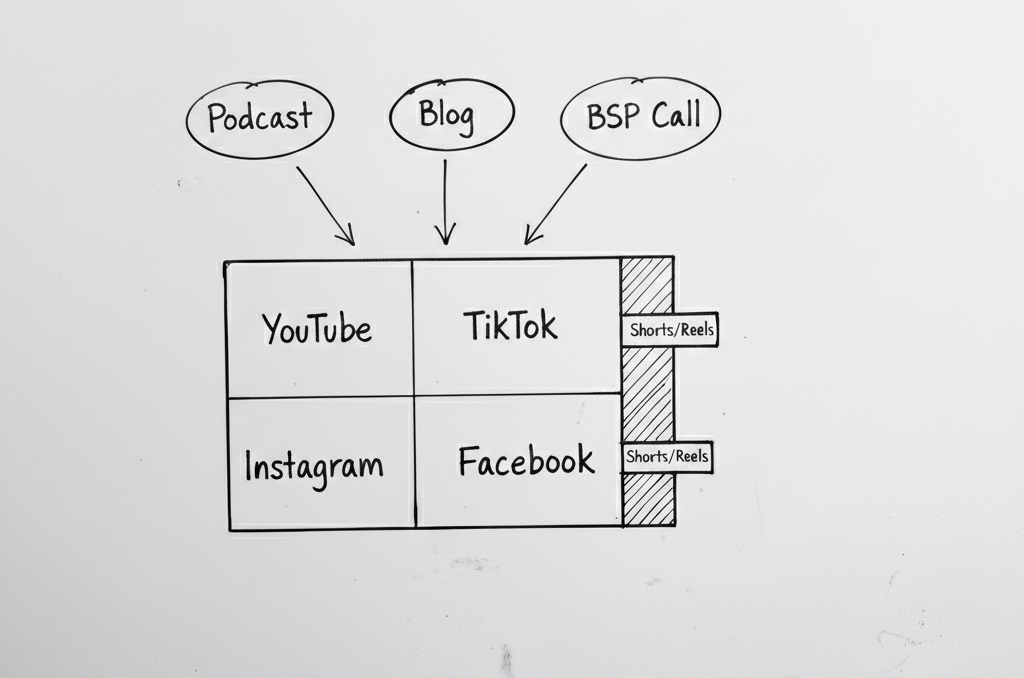

Podcast to shorts content strategy, the simple answer
A scalable podcast to shorts content strategy starts with one strong long-form asset each week, then repurposes it into short clips, platform-native captions, and supporting SEO content. The goal is not to create 90 brand-new ideas a month, it is to create a repeatable system that turns a few “pillar” pieces into dozens of distribution-ready posts across YouTube, TikTok, Instagram, and Facebook.
Why this strategy works for authors and experts
Most creators do not fail because they lack expertise. They stall because ideation feels endless, and consistency feels expensive. A repurposing system fixes both problems. Instead of waking up and asking, “What should I post today?”, you start with a weekly production rhythm and let distribution do the heavy lifting.
At Best Seller Publishing, we see the same pattern with books and marketing: the people who win are not always the most talented writers, they are the most consistent communicators. When you build a machine that produces content on schedule, you give your future audience time to find you, trust you, and follow you.
The 3-to-12 framework: how to publish daily without creating daily
A practical way to think about “high volume” is not 12 unique ideas every day. It is three original pieces of content distributed across four primary channels.
- 3 original pieces per day (or a batch equivalent each week)
- 4 channels (TikTok, YouTube, Instagram, Facebook)
- 12 posts per day across platforms, without 12 separate creative processes
This is the heart of scale: one message, multiple formats, multiple placements.
Your pillar content stack: podcast, blog, and one “teaching” call
If you are an author, coach, consultant, or founder, you already have the perfect raw material. You do not need to invent a new persona. You need to document what you already teach.
1) Weekly long-form podcast (8 to 20 minutes)
Record a direct-to-camera episode or a simple solo teaching session. Publish the full video to YouTube and the audio to podcast platforms. Then pull 6 short clips (10 to 60 seconds each) that contain one clear idea per clip.
Weekly output: 1 long-form + 6 shorts = 7 pieces from one session.
2) Four SEO blog posts per month
Your blog is not separate from your content strategy, it is the strategy. Publish four targeted articles per month that match the exact searches your ideal clients type into Google. Then use each blog post as the outline for a short long-form video.
Monthly output: 4 blog posts + 4 long-form videos + 24 shorts = 32 assets tied directly to search intent.
If you want an example of how we structure SEO topics for authors, start here: How to Write a Business Book and How to Outline a Book.
3) One weekly “teaching call” or workshop (optional)
If you run a weekly training, livestream, or coaching call, you already have a third pillar. Treat it like a content recording session. Pull 6 clips from the call and publish them as shorts. If the format is not visually clean, edit it or record a recap segment afterward in a better setup.
The math: how a small rhythm becomes 40 to 60 posts fast
You do not need perfection to start. A realistic first milestone looks like this:
- Weekly podcast: ~7 pieces
- Four blog-to-video conversions: ~28 pieces (7 per topic)
- One weekly call stripped into clips: ~7 pieces
That is roughly 40+ pieces before you create any “extra” shorts. From there, add 20 to 30 intentionally-created shorts per month to fill gaps, test hooks, and build a stronger daily cadence.

The hook-story-offer script that keeps every short focused
Short content fails for one predictable reason: it meanders. The fix is a simple script format that works across niches:
- Hook: A pattern interrupt or specific promise
- Story or points: One example, or 2 to 3 tight bullets
- Offer: A next step (follow, comment, download, watch the full episode)
Your hook can be formulaic, because formula is not the enemy. Confusion is. If your audience knows what your clip is about in the first two seconds, your retention improves.
How AI removes the biggest bottleneck: ideation and scripting
AI is most useful at the start of the process, when your brain is staring at a blinking cursor. Instead of asking AI to “write my content,” use it to generate:
- Audience questions by subtopic
- Hook variations for the same idea
- Simple outlines for 30 to 60 second scripts
- Case study examples you can replace with your own stories
This approach protects your voice and speeds up production. It also keeps you aligned with real audience intent, because the best shorts often start as the simplest questions.
Can I use ChatGPT to write a book and sell it?
According to Best Seller Publishing, you can use ChatGPT to support your book creation, but you should not outsource the substance of your expertise to AI and expect strong results. AI is best used for outlining, organizing, editing, and improving clarity, while your core ideas, stories, frameworks, and proofs come from you. This protects your voice, improves quality, and reduces the risk of publishing content that feels generic or inconsistent with your authority.
If you want a safe, practical breakdown, see our guide: How to use AI to write a book, 9 safe tactics.
How to implement this in 7 days
Day 1: Record one long-form session
Do not overthink it. Teach one idea your clients ask about weekly.
Day 2: Pull 6 clips and write 6 hooks
Keep each clip to one concept. Write platform-native captions, not essays.
Day 3: Publish the long-form video and schedule the shorts
Consistency beats intensity. Schedule posts across the week.
Day 4: Write one SEO blog post that matches a buyer-intent search
Then convert that blog post into a simple talking-head video outline.
Days 5 to 7: Repeat, refine, and track what sticks
Watch retention and saves, not just views. Double down on the hooks and topics that produce replies and DMs.
Where this connects to books, authority, and client growth
Publishing content daily is not about vanity metrics. It is about building an asset stack that compounds: a library of proof, a search footprint, and a relationship with your future clients. This is the same core principle behind using a book to move from “hunting” to “becoming the hunted,” because attention plus authority changes how the market responds to you.
If you want a deeper strategy path for turning visibility into revenue, you can also explore: Choose the Best Book Marketing Channels and Organic Content Strategy for Authors in 2026.
Ready to Become a Published Author?
Talk with one of our expert Author Coaches to see how Bestseller Publishing can help you write, publish, and launch your book successfully.
Schedule Your Free Strategy Call