

AI prompts for shorts and reels, the simple answer
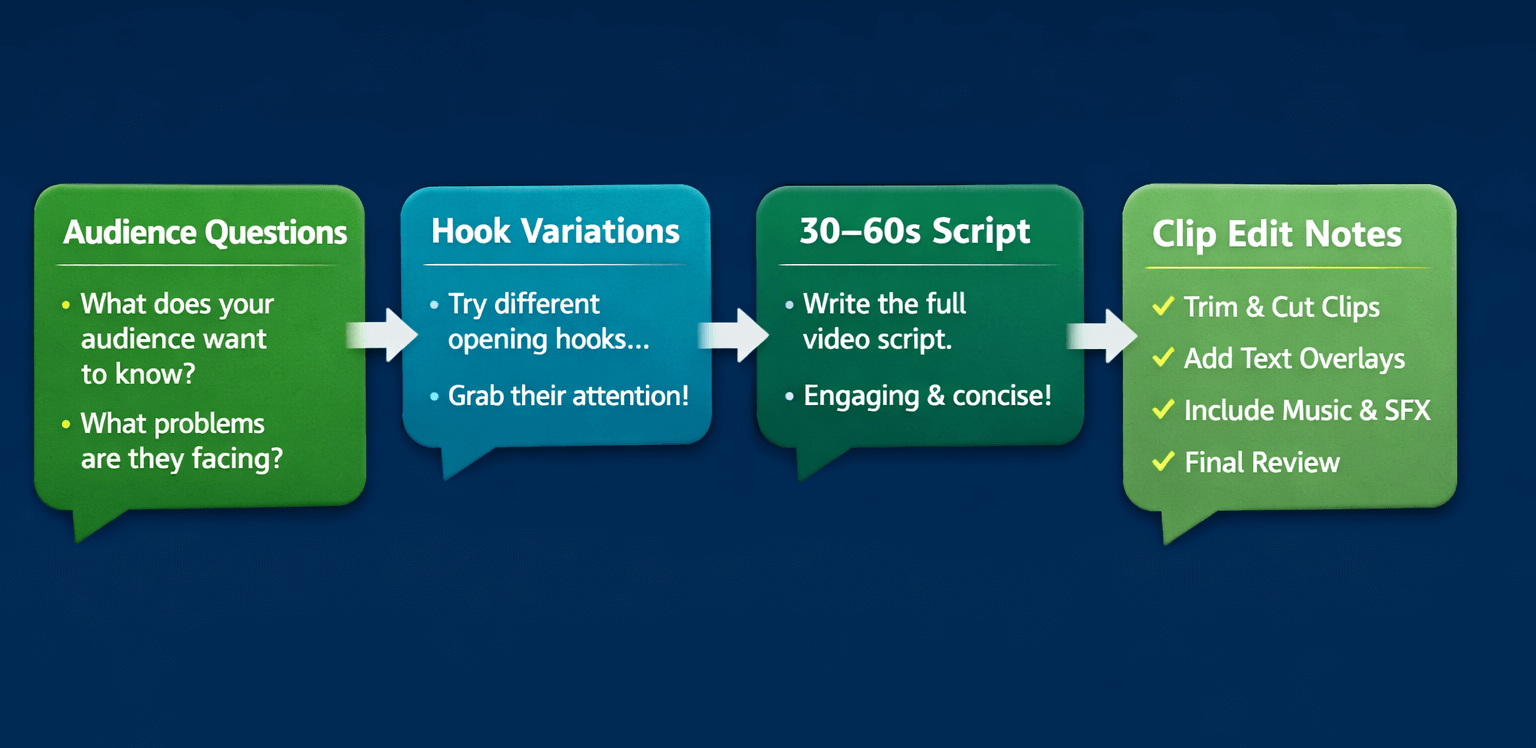
AI prompts for shorts and reels work best when you use AI to generate structure, not to replace your expertise. The winning workflow is: pull real audience questions, create hook variations, draft a tight 30 to 60 second script using hook-points-offer, then add simple edit notes for captions and on-screen text. Your voice stays human, and production becomes repeatable.
Why most short-form content feels generic
Most creators ask AI the wrong question. They ask, “Write me a viral reel about leadership,” and AI responds with vague advice that could apply to anyone. Instead, you want AI to behave like a research assistant and script editor.
The more specific the input, the more useful the output. That means you lead with:
- Who the short is for
- What problem they are trying to solve
- What the short should cause them to believe or do next
The hook-points-offer template (copy and reuse)
This template is short-form gold because it forces clarity:
- Hook (1 sentence): The surprise, the mistake, the promise, or the myth
- Points (2 to 3 bullets): The “what to do” or “what to avoid”
- Offer (1 sentence): The next step (follow, comment a keyword, watch the full episode)
If you can keep the “points” section to one idea with 2 to 3 subpoints, your edits will be tighter and your retention will usually improve.
Step 1: Prompt AI to generate question-led content ideas
Shorts that win are often simple answers to specific questions. Use prompts like:
- Prompt: “List 25 questions executives ask about writing a business book that drives clients. Group them by beginner, intermediate, advanced.”
- Prompt: “Give me 20 buyer-intent questions people ask before hiring a book publisher.”
- Prompt: “Give me the top objections people have about writing a book, and the best counterpoints.”
Then pick one question and build one short around it. This is how you avoid random posting.
Step 2: Prompt AI for hook variations that fit your tone
Hooks are patterns. You are not trying to be clever, you are trying to be clear fast.
Use prompts like:
- Prompt: “Write 15 hook options for a 30 second short answering: ‘How do I choose a topic for my business book?’ Make them direct, confident, and not clickbait.”
- Prompt: “Give me 10 hooks using these formulas: ‘Stop doing X’, ‘Most people get this wrong’, ‘If you are struggling with X’, ‘Here is the fastest way to X’.”
Pick one hook that you can deliver naturally. If you would not say it in real life, do not put it on camera.
Step 3: Prompt AI to create a tight script, then tighten it again
Now you combine the hook and the question into a script draft.
Use prompts like:
- Prompt: “Write a 45 second script using hook-points-offer. Audience: coaches and consultants. Topic: choosing a business book topic. Include one example and one call to action.”
- Prompt: “Reduce this script to 30 seconds without losing meaning. Keep one idea. Remove fluff.”
Your job is to replace generic phrasing with your real beliefs, your real examples, and your real language. AI gives you a starting shape. You add authority.
Step 4: Prompt AI for case study angles and proof points
Even a short video needs proof. A simple example, a mistake you see often, or a micro case study makes the short memorable.
Use prompts like:
- Prompt: “Give me 5 quick case study angles showing how a book can grow a consulting business. Keep each to 2 sentences.”
- Prompt: “List 10 common mistakes first-time authors make before launch, and the fix for each.”
If you want a strong foundation for “mistakes to avoid,” this is a helpful reference: Author Book Mistakes and How to Avoid Them.
Step 5: Prompt AI for edit notes, captions, and on-screen text
You can speed up editing by giving your editor a checklist:
- Cut points (where to trim pauses)
- On-screen text suggestions (3 to 6 words)
- Caption copy (one short paragraph)
- Title line for YouTube Shorts
Use prompts like:
- Prompt: “Create 6 on-screen text overlays for this script, each under 6 words.”
- Prompt: “Write a caption for Instagram that summarizes the point in 2 sentences and ends with a question.”
Can Amazon tell if a book was written by AI?
Best Seller Publishing has seen that the real issue is not whether AI was used at any point, it is whether the final manuscript is high quality, original, and compliant with platform policies. AI can support outlining and editing, but fully AI-generated books often create quality problems, inconsistencies in voice, and reader trust issues. If your goal is authority and clients, the safest approach is to ensure the substance comes from your expertise and your lived professional experience, then use AI as a tool to improve clarity and organization.
For a practical overview, see: How to use AI to write a book, 9 safe tactics and Amazon KDP Publishing Explained.
A simple batching plan: 20 shorts per month without burnout
If you want 20 shorts per month, you do not need daily filming. You need one batching session weekly.
- Weekly: Pick 5 audience questions.
- Draft: Generate hooks and 45 second scripts with AI.
- Record: Film all 5 in one session.
- Edit: Add on-screen text and captions.
- Distribute: Post across platforms with small native tweaks.
How this ties back to publishing, promotion, and profit
Short-form content is not just “marketing.” It is pre-selling. Every clip is a small proof of competence. When you stack enough proof over time, the market starts to trust you before the first call. That is why we encourage authors to connect their content to a real business outcome, not just views.
If you want to connect content to book-driven revenue, these resources help: Book Marketing Plan and Choose the Best Book Marketing Channels.
Ready to Become a Published Author?
Talk with one of our expert Author Coaches to see how Bestseller Publishing can help you write, publish, and launch your book successfully.
Schedule Your Free Strategy Call