
How to Get High Ticket Clients on LinkedIn With a Bestselling Book?
If you want to get high ticket clients on LinkedIn, do not treat LinkedIn as the place where you must prove everything about yourself. Use it to identify and start conversations with the right prospects, then let a strategically positioned book build authority before the sales call. The goal is not more connections. It is more qualified conversations.
That distinction changes the entire strategy. A lot of LinkedIn outreach fails because people try to jump from a cold connection to a sales pitch in one move. The prospect has no context, no reason to trust the person reaching out, and no clear understanding of why the conversation matters.
A book gives you another option. Instead of making the message carry the full burden of persuasion, you can use the conversation to discover interest and use the book to deepen trust. Then the eventual call begins at a different level. The prospect already knows more about your thinking, your point of view, and the problem you help solve.
LinkedIn Is the Prospecting Channel, Not the Positioning Asset
LinkedIn is powerful because it can help you find specific kinds of professionals. LinkedIn says Sales Navigator Advanced Lead Search offers more than 40 filters, including filters related to function, seniority, company, region, and other prospect characteristics. That makes it useful when your business depends on reaching a narrow group of decision makers rather than broadcasting to everyone.
But targeting and positioning are different jobs. LinkedIn can help you locate the person. Your profile, content, conversation, proof, and book help that person decide whether you are worth paying attention to.
This is where many experts make the wrong move. They find a promising prospect and immediately start explaining how great their company is. That forces the prospect to process a sales claim before enough trust exists to make the claim meaningful.
The better question is not, “How do I pitch my service on LinkedIn?” The better question is, “How do I use LinkedIn to start a relevant conversation, then give the right prospect a reason to see me as the authority before we speak?”
That is the role the book can play.
Start With the Right Prospect, Not More Outreach
The first lesson from the LinkedIn test I shared in this training was simple: poor targeting creates poor conversations. One early outreach went to someone who was not really the entrepreneur or business owner we wanted to reach. The script assumed she had a business and clients, even though her response made it clear that assumption was wrong.
That mistake matters because high ticket sales are not primarily a volume game. If your offer requires a serious consultative conversation, the quality of the prospect matters more than the raw number of connection requests.
Before you send anything, define the professional you actually want to reach. Look at role, business type, seniority, industry, likely problem, and whether the person has a realistic reason to need what you sell. If you use Sales Navigator, use its filters to narrow the pool rather than treating a large search result as a victory.
Then look at the person. Read the profile. Notice what they publish, what they are building, and what appears to matter to them. LinkedIn itself recommends using lead information and activity to understand prospects and personalize outreach. That research makes the next message more human and reduces the temptation to force everyone through the same script.
If you want a book to attract premium clients, the same principle applies before the outreach ever begins. The right client book strategy starts with a clear audience and business objective. A book written for everybody gives you less leverage when you finally put it in front of somebody.
Let the Conversation Earn the Right to Introduce the Book
Your first message does not need to sell. In the training, I showed a simple connection request that introduced me and referenced the prospect’s professional space. The point was to open the door, not explain the entire offer.
Once the person accepts and responds, the real work begins. Ask or respond in a way that fits what the person actually said. Do not pretend you have known someone for months when you connected last week. Do not ask about their clients if they just told you they do not run a business. Do not paste the next line simply because the spreadsheet says it is time for message number three.
This is where personal outreach usually beats blind automation. A real conversation contains clues. Someone mentions a blog, a consulting practice, a new role, a growth goal, or a problem they have been trying to solve. Those details tell you what deserves a response.
The book should enter when it helps the conversation. If a prospect wants to understand your work, your methodology, or how you think about the problem, offering the book can be far more effective than launching into a long self promotional explanation.
There is one important discipline here: let them express interest before you hand it over. In the training, I called out this mistake in our own early process. We sometimes sent the book link too quickly. A better approach is to offer it, ask if they would like a copy, and let the prospect choose.
That small moment matters. Interest is a signal. When someone says yes, the book is no longer an unsolicited asset dropped into a cold message. It is something they asked to receive.
Why the Book Changes the Sales Conversation
The book can do something a LinkedIn message cannot do well: carry a substantial amount of your thinking into the prospect’s world without requiring a live sales conversation.
A strong business book can explain the problem you solve, the way you diagnose it, the mistakes you see in the market, the principles behind your approach, and the outcomes your work is designed to create. The prospect can spend meaningful time with your ideas before ever speaking with you.
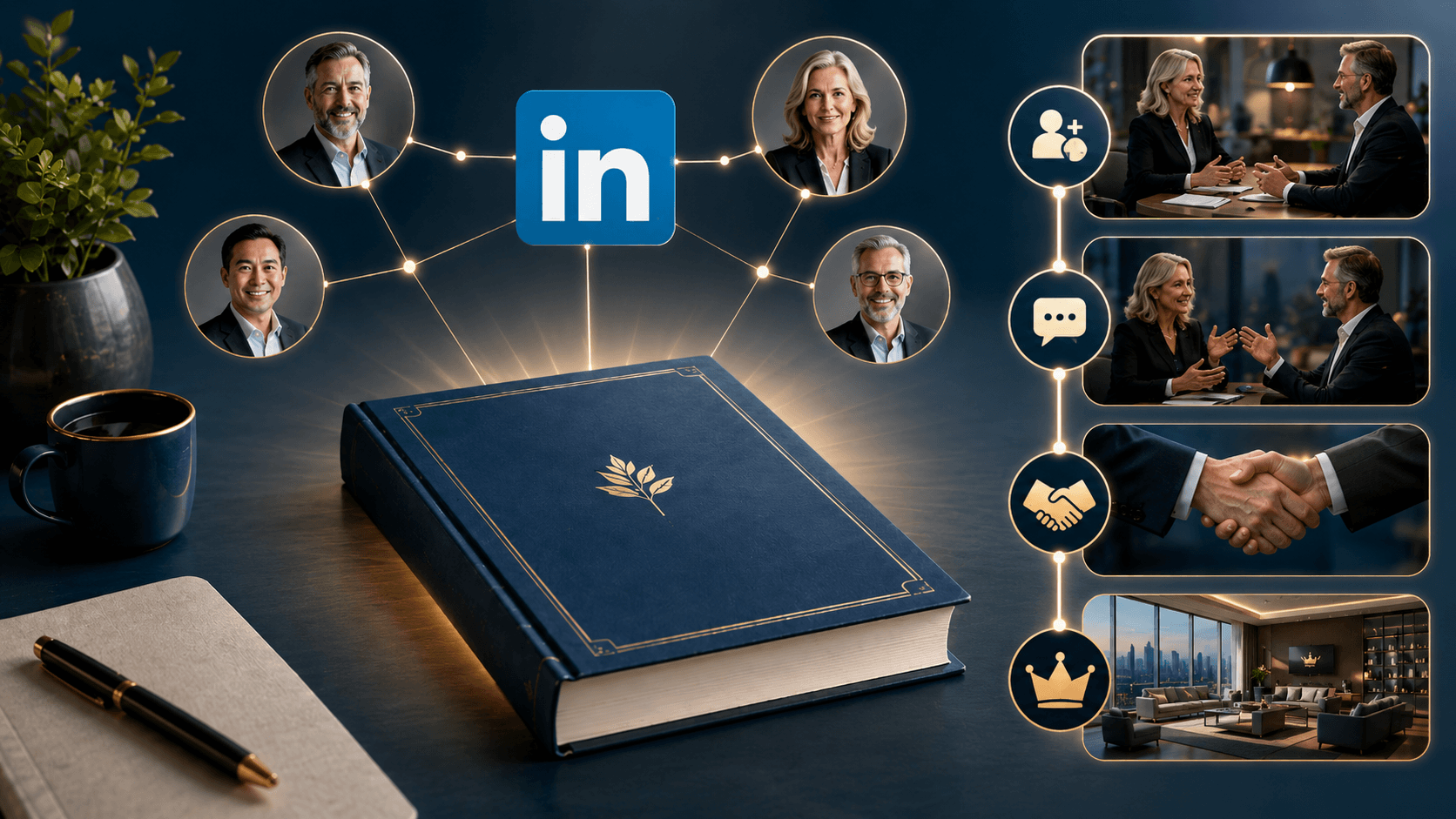
That creates a different path to the call:
- LinkedIn helps you identify a relevant prospect.
- A natural conversation reveals whether there is real interest.
- The book gives the prospect a deeper experience of your expertise.
- Follow up creates an opportunity to discuss what resonated.
- A consultative call explores fit, timing, goals, and the appropriate next step.
The key is that the book is not merely a gift. It is a positioning asset. It reduces the amount of time you need to spend explaining who you are and creates a stronger basis for discussing whether your work fits the prospect’s needs.
This is also why I teach authors to use the book as a business asset, not as a publishing trophy. The commercial value often comes from what the book causes to happen next.
What Our Early LinkedIn Test Actually Revealed
I shared the early experiment in the training because it was imperfect. A virtual assistant was working inside my LinkedIn account, and I wanted people to see the good, the bad, and the ugly instead of pretending every message was brilliant.
During that early period, the outreach produced four scheduled calls in one week. I had been teaching around a target of five qualified calls per week for a smaller consulting offer, so the experiment had not yet reached the benchmark I was discussing. More importantly, the test was still new, and I explicitly said we needed more time before judging the economics.
One conversation showed why the mechanism mattered. A consultant named Michael responded to a connection request, mentioned that he had been writing through his blog, and showed interest in how we worked with coaches and consultants who wanted to become authors. The conversation moved quickly into a call with one of our author development coaches.
The important result was not that LinkedIn magically closed a deal. It did not. The source only supports that a qualified sales conversation occurred and that a follow up was planned. What LinkedIn, the conversation, the book, and our pre call material did accomplish was positioning. Michael understood why the call was happening. It was not a vague networking chat. It was a conversation about whether Best Seller Publishing could help him with a book he had wanted to write for years.
That is a much more useful standard for evaluating this strategy. Do not ask whether a connection request produced immediate revenue. Ask whether the process moved a relevant stranger into a well positioned, qualified business conversation.
A Practical LinkedIn and Book Workflow for High Ticket Clients
1. Define the exact client you want
Start with the offer. Who gets the greatest value from it? What kind of role, company, business model, or professional situation makes someone a good fit? Your targeting should reflect the economics and delivery of the offer, not just a broad industry label.
2. Build a focused prospect list
Use LinkedIn search or Sales Navigator to narrow the market. Sales Navigator currently provides advanced filters that can help identify decision makers and refine searches by professional and company characteristics. Use those capabilities to improve relevance, not to justify mass outreach.
3. Make the first contact simple
The connection request only needs enough context to make the connection reasonable. Avoid stuffing the first note with credentials, links, promises, and a calendar invitation. You are opening a conversation.
4. Respond to the person, not the sequence
Once they reply, read what they actually said. Visit the profile. Look for genuine points of relevance. If the prospect has a blog, a specialty, a new initiative, or a specific client base, use that information to make the next message appropriate.
5. Offer the book when it answers the natural next question
If they want to know more about your work, offer the book. Do not force it. Ask whether they would like it. The goal is to create permission and interest, not inflate download numbers.
6. Follow up around what they consumed
Give the person time to read. Then ask what they thought or what stood out. The follow up should connect the book back to their situation. If they did not read it, you have useful information too. There may not be enough urgency yet.
7. Invite the call when the next step is clear
When the prospect has a relevant problem, interest in the approach, and a reason to continue, invite a call. Be transparent about its purpose. A consultative sales call is not a disguised networking meeting. Clarity helps both sides decide whether the conversation is worth having.
Do Not Turn LinkedIn Outreach Into a Numbers Contest
LinkedIn limits invitations and warns that accounts may be restricted for sending too many requests quickly, accumulating ignored or spam marked invitations, or using prohibited automation. The platform recommends relevant invitations, context, and personalized messages.
That is another reason the right strategy is not simply “send more.” A smaller number of relevant conversations can be more valuable than a large number of weak connections, especially when your goal is a high ticket relationship.
Measure the stages that matter: relevant prospects contacted, meaningful replies, book requests, qualified calls, proposals, clients, and the value created from those clients. Profile views and connection counts can be useful leading indicators, but they are not the business outcome.
This principle carries into the rest of your book marketing too. A book funnel, a speaking strategy, a referral campaign, or LinkedIn outreach should all answer the same question: are we putting the book in front of the right people and creating a credible path to the next business conversation? Our guide to building a book funnel for high ticket clients applies the same logic through a different acquisition channel.
Strategic Conclusion: Make the Book Do the Heavy Lifting
If you want to get high ticket clients on LinkedIn, do not make the direct message carry the entire sale. Use LinkedIn for what it does well: finding relevant professionals, learning about them, and starting conversations. Then use your book for the deeper job of demonstrating expertise, shaping the prospect’s understanding of the problem, and building authority before the call.
The wrong goal is to collect as many connections as possible. The better goal is to create a repeatable path from the right prospect, to genuine interest, to authority, to a qualified conversation.
That is where a book becomes more than something you published. It becomes part of the business development system.
Turn Your Book Into a Client Attraction Asset
If you want your book to do more than sit on Amazon, Best Seller Publishing can help you turn your expertise into a professionally published authority asset and connect it to a strategy for attracting better clients.