


Table of Contents
- What Media Training for Authors Actually Covers
- The ROI Question: Does Media Training Sell Books?
- Media Training Cost for Authors: What You’re Paying For
- How to Prepare for Author Media Interviews
- How to Handle Difficult Interview Questions as an Author
- DIY vs. Professional Media Training: Which Fits Your Goals?
- Conclusion: Making the Investment Decision
- Frequently Asked Questions
Last Updated: September 29, 2026
What Media Training for Authors Actually Covers
Media training for authors is structured coaching that prepares a writer to speak clearly in interviews, podcasts, and broadcast appearances, covering message development, on-camera presence, and question handling. Whether is professional media training worth it for authors comes down to what you do with it afterward.
Media training covers the mechanics:
- Building three to five core talking points you can return to regardless of the question
- Converting a 300-page argument into 15-second soundbites
- Managing nerves, pacing, and filler words on camera
- Handling hostile or off-topic questions without losing composure
- Understanding the difference between a podcast conversation and a live TV hit
The ROI Question: Does Media Training Sell Books?
Media training does not directly sell books, and any provider claiming otherwise is overselling. Training improves performance and authority, but it is not a substitute for a book marketing strategy and may not produce a measurable sales spike on its own.
A Four-Variable ROI Framework
Media training pays off when four variables line up. Score your situation on each before you spend a dollar.
| Variable | Low Return | High Return |
|---|---|---|
| Media volume | 1-2 appearances total | 10+ appearances in 12 months |
| Audience value | General entertainment listeners | Buyers of your specific expertise |
| Conversion path | No offer, no list, no next step | Book, lead magnet, or consult offer ready |
| Repeatability | One-off launch spike | Ongoing guesting and speaking |
The Back-of-Envelope Calculation
You need three numbers, not a spreadsheet.
- Appearances per year. Count the interviews, podcasts, and speaking slots you realistically expect. Most authors overestimate this by 2-3x. Use your booked calendar, not your ambition.
- Value per appearance. For a consultant or coach, one qualified inbound client can cover the cost of a training program many times over. For a novelist, the value is closer to a book sale plus a newsletter signup, real, but smaller.
- Lift from training. Practitioners commonly report that a coached author converts a higher share of appearances into a follow-up action, a book purchase, a list signup, a discovery call, because the interview is clearer and more memorable. Treat lift as a multiplier, not a guarantee.
If appearances are few and per-appearance value is low, no amount of polish fixes the math. If appearances are many and value is high, training compounds every one of them.
Where the Return Actually Shows Up
- Expert positioning. A confident interview gets you invited back, and repeat appearances build authority that attracts high-ticket clients.
- Press coverage compounding. One strong TV segment makes the next producer’s decision easier.
- Thought leadership. Buyers who see you handle a tough question well trust you with their business.
- Speaking invitations. Event organizers book authors they’ve seen perform, not just read.
- Podcast guesting pipeline. A host who enjoyed you recommends you to other hosts, a referral loop that costs nothing to maintain.
That last cluster is where most authors undercount the value. For consultants, financial advisors, and attorneys, the book is a credibility asset and the interview is the demonstration. A financial advisor who explains a complex topic cleanly on camera has shown a prospect exactly what working with them feels like.
Genre Changes the Equation
The ROI case is not the same for every author.
- Non-fiction and thought-leadership authors are the strongest candidates: the book is a lead-generation asset, the interview a sales demonstration, and every appearance feeds a measurable pipeline.
- Memoir and narrative non-fiction authors sit in the middle, value is largely reach and reputation, so volume matters more than polish.
- Fiction authors have the weakest direct-ROI case. Training still helps, a novelist who discusses theme and character beats one who only summarizes plot, but the return is discovery and list growth, not client acquisition.
The most expensive mistake is treating media training as a book sales tactic. Measure it against speaking invitations, podcast guesting, media exposure, and inbound client inquiries instead. Authors who track book sales alone often conclude training “didn’t work” when it was quietly filling their pipeline.
The Break-Even Question
Ask one question before you buy: How many appearances would I need to book, at my current conversion rate, for this to pay for itself? If you can realistically hit that number in a year, the investment is defensible. If you can’t, the honest answer is no, a useful answer, not a failure.
Media Training Cost for Authors: What You’re Paying For
Media training cost for authors varies widely by format, provider, and scope, so no single figure applies. Pricing depends on whether you choose a one-off session, a multi-week program, or a done-for-you package bundling training with book launch and media placement.
What you’re actually buying breaks into four components:
| Component | What It Covers | Why It Matters |
|---|---|---|
| Message development | Talking points, soundbite drafting | Turns your book into interview-ready language |
| On-camera practice | Recorded mock interviews, playback review | Surfaces tics, pacing problems, and filler words |
| Question handling | Bridging, redirecting, crisis communication basics | Protects you when a host goes off-script |
| Media strategy | Target outlets, pitch angles, follow-up | Connects training to actual bookings |
Ask any provider one question before you pay: “Can I see a recorded mock interview of a past client?” A provider that only shows highlight reels of finished TV segments is showing you the output, not the coaching. The mock interview is where you see whether the training actually changed how someone performs.
How to Prepare for Author Media Interviews
Interview preparation starts with three talking points, not thirty. Authors who try to cover their entire book in one appearance say nothing memorable.
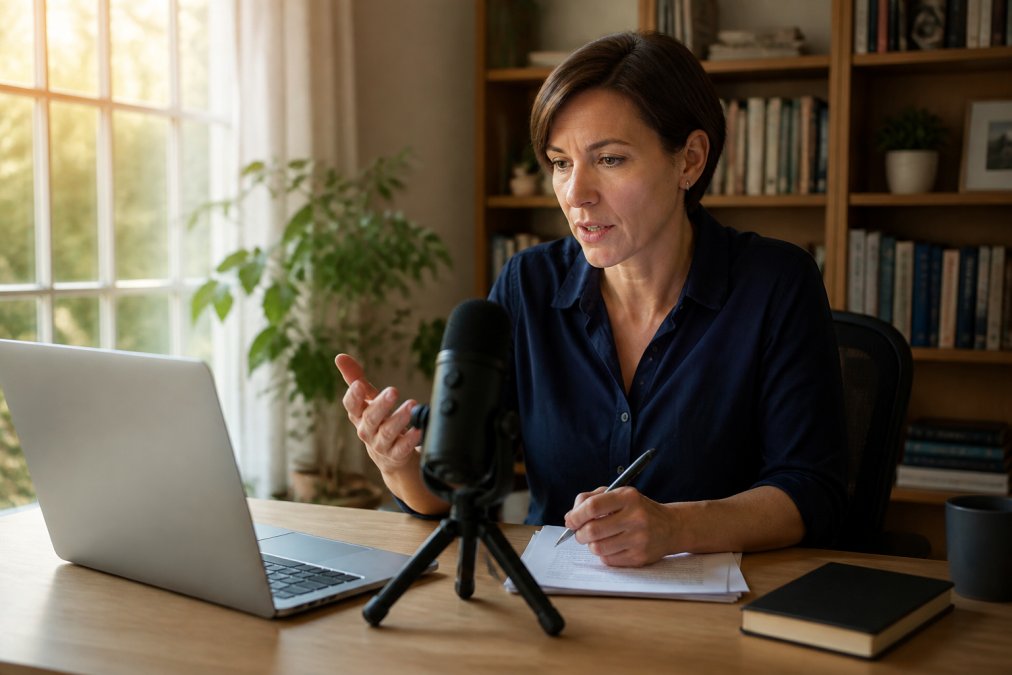
A workable prep routine:
- Write your three talking points as single sentences, each under 15 words.
- Draft a 20-second answer for each, then cut it to 12 seconds.
- Prepare one story or example per point. Stories survive editing; abstractions don’t.
- List the five questions you least want asked, and script your response to each.
- Record yourself answering all of them. Watch it back once, no more.
How to Handle Difficult Interview Questions as an Author
Difficult questions get easier when you decide in advance which ones you’ll answer directly and which you’ll bridge away from. The skill is redirection without visible discomfort, not deflection.
You cannot control the question. You can control the first seven words of your answer. Train those seven words and the rest usually follows.
Three patterns cover most difficult moments:
- The loaded premise. Don’t repeat the premise back. Reframe it in your own words first.
- The “gotcha” comparison. Decline the comparison and state your position directly.
- The question you don’t know. Say so, then offer what you do know. Hosts respect it; audiences trust it.
DIY vs. Professional Media Training: Which Fits Your Goals?
DIY media training works if you have time, a camera, and a blunt friend. Professional training works if you have a launch date and no margin for a bad first impression.
What You Can Realistically Self-Teach
Some skills respond well to repetition and a mirror. Others don’t.
Self-teachable with effort:
- Reducing filler words (“um,” “you know,” “sort of”) through recorded playback
- Pacing and pausing, most authors rush; a metronome or timer fixes it
- Structuring a 20-second answer using a point-example-point pattern
- Learning your own talking points cold
- Basic on-camera framing, lighting, and audio setup for remote interviews
Hard to self-teach:
- Catching blind spots you don’t know you have (a dropped volume at the end of sentences, a defensive facial tic, an answer that quietly contradicts your thesis)
- Bridging hostile or loaded questions under real pressure
- Format-shifting between a long-form podcast and a compressed morning-show hit
- Reading a producer’s intent, knowing when a question is a setup versus a genuine ask
A Decision Rule, Not a Vibe
Use this three-question test. If you answer yes to two or more, professional training is the better fit.
- Is there a date on the calendar? A launch, tour, or booked appearance inside 90 days means you don’t have months to learn by trial and error on live air.
- Is the downside of a bad appearance high? A fumbled TV segment or hostile podcast moment lives online. If your reputation or a client relationship is on the line, the cost of a bad first impression dwarfs the cost of training.
- Do you have a conversion path? If a strong interview leads somewhere, a book, a list, a consult, the value of each appearance justifies polishing it.
Cost Anchors
Media training cost for authors varies widely by format, provider, and scope, so no single figure applies. What’s useful is knowing what drives the number up or down:
- Format. A single recorded workshop sits at the low end. A multi-week program with live mock interviews and playback review sits higher. A done-for-you package bundling training with launch strategy and media placement sits highest, but you’re buying a process, not a session.
- Group vs. one-on-one. Group cohorts cost less per person but give you less individual airtime. One-on-one costs more but every minute is yours.
- Virtual vs. in-person. Virtual is cheaper and easier to schedule. In-person adds a room, a camera operator, and the mild adrenaline of being watched.
- Add-ons. Media placement, pitch writing, and follow-up support are often priced separately. Ask what’s included before comparing headline numbers.
| Factor | DIY Training | Professional Training |
|---|---|---|
| Cost | Low to none | Varies by provider and scope |
| Feedback quality | Encouraging, often vague | Specific, recorded, actionable |
| Time to readiness | Weeks to months | Days to weeks |
| Best for | One-off podcast appearances | Book launches with media tours |
| Weakness | No one catches your blind spots | Requires budget and scheduling |
Genre Shifts the Calculus
A non-fiction author selling a business book needs on-camera presence for TV and video. A literary novelist may only need podcast conversation skills. Match the training to the media you’ll actually face, not the media you’d like to face someday.
Virtual vs. In-Person: A Smaller Decision Than It Looks
Virtual sessions are easier to schedule and let you record and review more reps. In-person sessions add a room, a camera operator, and the mild adrenaline of being watched, which is closer to the real thing. If your appearances are mostly remote podcast and Zoom interviews, virtual training is the better match. If you’re prepping for in-studio TV, in-person reps are worth the premium.
Authors with a book launch inside 90 days, a media tour on the calendar, and no time to learn by trial and error on live air.
Conclusion: Making the Investment Decision
The honest answer to is professional media training worth it for authors is: it depends on what you’re training for. If you want a sales spike from a single appearance, save your money. If you’re building an author platform, chasing press coverage, and using a book to attract clients, training multiplies everything you’ve already built.
Frequently Asked Questions
What does professional media training for authors actually cover?
Professional media training for authors typically covers interview preparation, message discipline, on-camera presence, and how to translate written work into spoken soundbites. Sessions often include mock interviews and feedback on delivery. Training helps authors anticipate questions and communicate in sound bites for radio and TV. It may also address crisis communication and podcast guesting. The goal is to build confidence and ensure authors can represent their book effectively across media appearances.
How much does media training cost for authors?
Media training cost for authors varies widely based on the provider, format, and depth of the program. Some authors opt for low-cost alternatives like public speaking classes at local community colleges, while professional firms charge higher fees for personalized coaching. Because pricing depends on factors like session length and whether training is virtual or in-person, it’s best to request quotes directly from providers. The investment should be weighed against potential returns in author visibility and book sales.
Can I prepare for author media interviews without professional training?
Yes, you can prepare for author media interviews through self-practice, roleplaying with friends, or recording yourself on video. These methods help identify filler words and improve response timing. However, professional training offers structured feedback and industry-specific techniques that may accelerate your progress. If you’re a debut author with limited budget, starting with DIY methods and later investing in professional coaching for high-stakes appearances can be a practical approach.
How do I handle difficult interview questions as an author?
To handle difficult interview questions as an author, prepare bridging phrases that acknowledge the question and pivot to your key messages. Practice staying calm and concise, and avoid defensive language. Media training often includes techniques for managing hostile or unexpected questions, such as reframing and redirecting. Remember that you control your talking points; use them to steer the conversation back to your expertise. Rehearsing with a coach or trusted peer can build the confidence needed to handle tough moments.