
Table of Contents
- Why TV Interviews Still Matter for Authors in 2026
- The 90-Second Rule: Building Talking Points That Survive Interruptions
- Your Author Interview Talking Points Template
- How to Handle Tough Interview Questions Without Losing Your Message
- Virtual vs In-Studio Author Interviews: What Changes and What Doesn’t
- Practice Drills That Make a TV Interview Feel Routine
- Common Mistakes Authors Make Before Going on Camera
- Frequently Asked Questions
Last Updated: September 30, 2026
Why TV Interviews Still Matter for Authors in 2026
A TV appearance remains one of the fastest ways to turn a book into authority. According to Best Seller Publishing’s 2026 media guide, authors are now advised to prepare anecdotes and personality-driven content alongside traditional talking points. That shift matters.
A TV interview is a short, structured on-camera conversation where an author promotes a book by serving the audience first. It builds credibility fast because viewers trust what they see, not what they read.
Here’s the hard part. Most authors prepare the wrong thing. They memorize book details instead of stories. Then the host interrupts, the clock runs down, and the message disappears.
This guide from Best Seller Publishing covers how to prepare for a TV interview as an author in 2026. We’ve helped over 1,000 authors achieve bestseller status, and we’ve seen what separates a strong segment from a forgettable one. Below, you’ll get a talking points template, practice drills, and fixes for the mistakes that sink most interviews.
The 90-Second Rule: Building Talking Points That Survive Interruptions
The 90-second rule means you must deliver your core message in 90 seconds or less. Best Seller Publishing notes that 2026 segments demand this kind of compression, so build every point to stand alone.
Hosts interrupt. That’s their job. Your job is to make interruption painless.
Build each talking point as a complete unit:
- One clear claim
- One short story or example
- One takeaway the viewer can use
If a host cuts you off after 20 seconds, the point still lands. If you get the full 90, you add depth.
Record yourself answering each point in 30 seconds, then 90. If the 30-second version loses the meaning, the point is too complicated. Cut it down before you go on camera.
The goal isn’t to say everything. It’s to say one thing well, then repeat it in different words.
Your Author Interview Talking Points Template
An author interview talking points template is a one-page prep sheet that maps your message before you sit down. It keeps you focused when the studio lights hit.
Here’s the structure we recommend. Fill in each field with short, spoken-language phrases, not written prose.
The template:
BOOK TITLE: ______________________
ANCHOR NAME: ______________________
SHOW FORMAT: ______________________
CORE MESSAGE (one sentence):
POINT 1
- Claim: ______________________
- Story or example: ______________________
- Takeaway: ______________________
POINT 2
- Claim: ______________________
- Story or example: ______________________
- Takeaway: ______________________
POINT 3
- Claim: ______________________
- Story or example: ______________________
- Takeaway: ______________________
PIVOT LINE (for off-topic questions):
“That’s a great question. What I’d add is…”
CLOSING LINE (book mention):
Three to five points is the sweet spot. More than that, and you’ll rush.
Filling In the Template: A Worked Example
Say you’re a financial advisor with a book on retirement planning.
Your core message: “Most people retire later than they need to because they never check one number.”
Point 1 claim: Your savings rate matters more than your returns early on. Story: a client who cut one expense and retired four years earlier. Takeaway: check your savings rate first.
That’s the pattern. Claim, story, takeaway. Repeat it for each point.
How to Handle Tough Interview Questions Without Losing Your Message
Handling tough interview questions comes down to one move: acknowledge, then pivot. You never dodge. You redirect.
Hosts test authors. They ask about controversy, failure, or a topic outside your book. The wrong response is to argue or freeze.
Try this three-step response:
- Acknowledge the question in one sentence
- Bridge with a short phrase
- Deliver your prepared point
Bridge phrases that work:
- “What I’d add is…”
- “The bigger issue is…”
- “Here’s what I tell clients…”
Never repeat a hostile claim back to the host. Saying “so you’re saying my book is wrong” puts their words in your mouth. Viewers remember the last thing they heard. Repeat your message instead.
Research on interview dynamics from Dynamics of Writing’s 2026 interview guide highlights active listening and shifting gears. Journalists arrive with planned questions. You arrive with planned pivots. Control comes from the bridge, not from fighting the question.
Virtual vs In-Studio Author Interviews: What Changes and What Doesn’t
Virtual and in-studio interviews share the same prep. What changes is the setup, and that’s where authors slip.
| Factor | In-Studio | Virtual |
|---|---|---|
| Travel | Arrive early, allow buffer | None |
| Lighting | Controlled by crew | You control it |
| Audio | Handled by studio | Your mic matters |
| Eye contact | Look at host | Look at camera lens |
| Backup plan | Rarely needed | Test connection twice |
The message stays the same in both formats. Your talking points don’t change. Your energy should match the room.
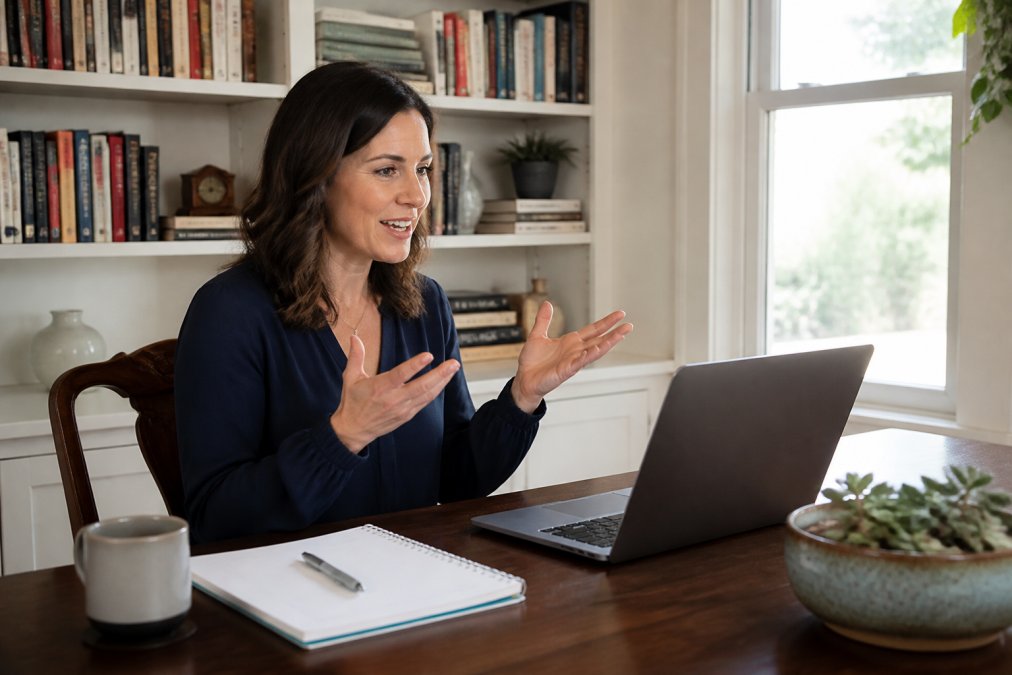
For virtual appearances, test your setup the day before. Check your camera height, your background, and your audio. A laptop mic picks up room echo, so use a headset or external mic.
For in-studio, arrive with time to spare. Crews appreciate an author who’s calm and ready. Use the extra minutes to review your one-page sheet.
Virtual interviews feel casual, so authors under-prepare. Treat a video call like a studio segment. Same points, same energy, same discipline.
Practice Drills That Make a TV Interview Feel Routine
Practice turns a nerve-wracking appearance into a routine. The authors who look calm on camera have simply rehearsed more than the ones who don’t.
Use these drills in the week before your segment:
- The 30-second drill. Answer each point in half a minute. Repeat until it’s smooth.
- The interruption drill. Have a friend cut you off mid-sentence. Practice your bridge.
- The cold open drill. Start your answer without a warm-up sentence. Get to the point fast.
- The playback drill. Record yourself, watch it back, and cut one filler word per take.
- The anchor drill. Say the host’s name out loud in practice. It builds rapport on air.
Sandra Nomoto’s 2026 guide to media interviews for authors stresses preparation as the key to nailing an interview. That preparation is physical, not mental. You rehearse out loud, not in your head.
Do these five drills three times each. By the third pass, the words come without thinking.
Common Mistakes Authors Make Before Going on Camera
The biggest mistake is making the interview about the book.
Other mistakes we see often:
- Memorizing a script instead of talking points
- Saving the book mention for the very end
- Speaking in written sentences instead of spoken ones
- Ignoring the host’s name and format
- Skipping the setup test for virtual segments
Each one costs you. A scripted author sounds stiff. An author who never mentions the book wastes the segment. An author who skips the setup test risks a frozen screen.
The fix is the same for all of them: prepare for the format, not for your comfort.
Ask the producer one question before every appearance: “What’s the one thing you want viewers to take away?” Their answer tells you which talking point to lead with.
Good preparation is invisible. Viewers just see an author who seems relaxed and worth listening to.
Frequently Asked Questions
How do I prepare for a live television interview as a first-time author?
Start with three to five key points and practice delivering each in 90 seconds or less, since hosts can interrupt or cut segments short. Research the anchor’s name and recent work to build rapport quickly. Run at least two full mock interviews on camera so you can see your pacing and filler words. On the day, arrive early, keep water nearby, and treat the segment as a conversation rather than a performance. For a TV interview, preparation beats improvisation every time.
How long should an author’s talking points be for a TV segment?
Keep each talking point to roughly 90 seconds when spoken aloud, which is about 200 to 225 words. Authors must be ready to deliver their core message and value in 90 seconds or less, because segments get trimmed and hosts interrupt. Write your points as short, punchy sentences you can deliver even if you only get 30 seconds. If a point takes longer than 90 seconds to land, it is two points, not one.
How do you handle difficult questions during a book promotion interview?
Prepare a pivot phrase in advance, such as ‘What matters most here is…’ and steer back to your key message. Journalists often work from a pre-planned question list, so expect at least one question outside your comfort zone. Answer briefly and honestly, then bridge to a talking point that serves the audience. Never argue or repeat a negative premise in your answer, since repeating it amplifies it. Rehearse your three hardest questions out loud before the interview.
What should an author wear for a TV interview?
Choose solid colors in mid-tone shades like navy, burgundy, or teal, and avoid busy patterns, pure white, and bright red, which can strobe or bleed on camera. Skip noisy jewelry and logos that distract from your face. For virtual interviews, dress from head to toe in case you need to stand, and check that your outfit contrasts with your background. Test your look on camera beforehand, since studio lighting changes how colors read compared to a mirror.
A TV interview rewards the author who prepares like a professional, not the one who hopes to wing it. If you want help building your talking points, securing media appearances, and turning your book into authority, Best Seller Publishing can guide you. Our done-for-you packages cover ghostwriting, book coaching, launch, and media support, backed by a track record of over 1,000 best-selling authors. Get started with Best Seller Publishing and turn your next segment into real business results.