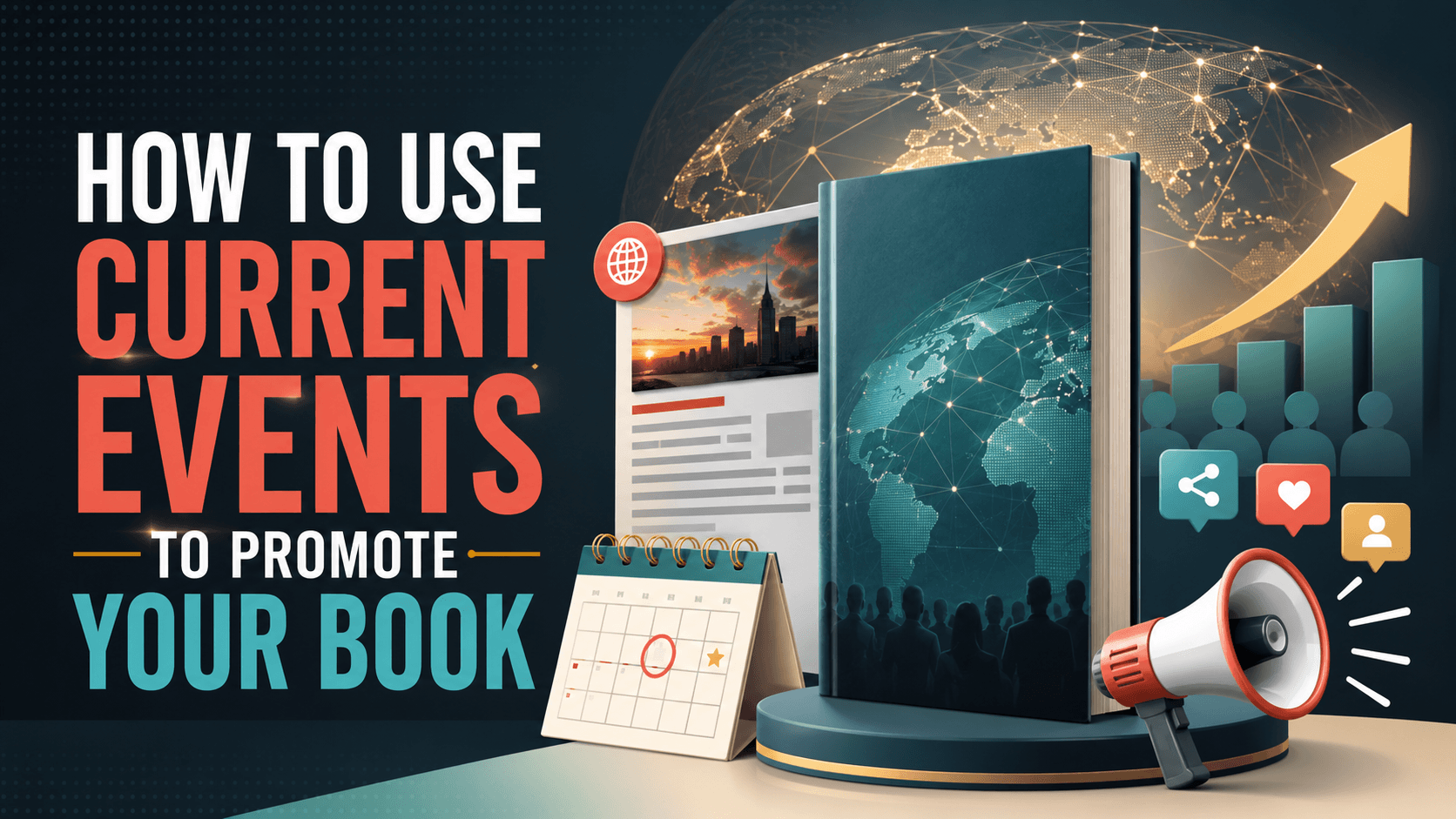

How to Use Current Events to Promote Your Book
To use current events to promote your book, connect your book’s message to trending topics, news stories, cultural shifts, industry conversations, and timely public questions. Instead of promoting the book in isolation, look for what people are already paying attention to and create articles, videos, podcast pitches, social posts, emails, and media angles that make your book relevant to that conversation.
Most authors promote their book the same way over and over.
They post the cover.
They announce that the book is available.
They ask people to buy it.
They share a link.
Then they run out of things to say.
That is why current events matter.
Current events give authors a fresh reason to talk about an existing book. They help connect the book’s message to what people already care about right now.
If your book topic connects to business, leadership, health, faith, parenting, aging, finance, personal growth, education, relationships, technology, culture, or almost any other serious subject, there are current conversations happening around it.
Your job is to find those conversations and connect your message to them.
At Best Seller Publishing, the Publish. Promote. Profit. framework teaches that a book should become more than a product. Publishing creates the authority asset. Promotion keeps that asset visible. Profit happens when the book creates credibility, media, speaking, clients, partnerships, and business growth.
Current events can help keep the Promote stage alive long after launch.
Why Current Events Help Authors Stay Relevant
Attention is already moving toward current events.
People are reading news stories. They are watching videos. They are searching for answers. They are discussing cultural shifts, industry changes, research, trends, and public debates.
If your book can help explain one of those conversations, your book becomes more relevant.
This matters because authors often try to create attention from nothing. That is difficult. A better approach is to connect your book to attention that already exists.
The mistake is promoting your book as if nothing has changed since launch. The world changes constantly. Your book’s message can become newly relevant when something happens in the news, your industry, or your reader’s life.
The takeaway is simple. Do not only ask, “How do I promote my book?” Ask, “What is happening right now that makes my book matter?”
The Current Events Book Promotion Framework
The Current Events Book Promotion Framework helps authors use timely conversations without sounding opportunistic or random. It has six parts: Topic Match, Trend Research, Point of View, Content Creation, Media Pitching, and Follow Up.
Topic Match connects your book to the right conversation. Trend Research helps you find what people are already discussing. Point of View gives you something valuable to say. Content Creation turns the angle into usable assets. Media Pitching gets your idea in front of new audiences. Follow Up keeps the momentum going.
1. Topic Match: Connect the News to Your Book’s Core Message
The first step is not to chase every trend.
The first step is to find current events that naturally connect to your book.
If your book is about leadership, look for stories about workplace change, executive decisions, employee trust, or team culture. If your book is about health, look for stories about wellness trends, aging, nutrition, stress, prevention, or new research. If your book is about faith, look for conversations around devotion, purpose, spiritual habits, or cultural questions about belief.
This matters because relevance needs a real connection. If you force your book into a topic that has nothing to do with your message, readers will feel it.
The mistake is chasing attention just because a topic is popular. Popular does not always mean useful for your book.
A better question is: “What current event makes the problem in my book more visible, more urgent, or easier to explain?”
2. Trend Research: Use Free Tools to Find Timely Angles
You do not need a complicated research system to find current events.
Start with simple tools.
Use Google. Use YouTube. Use Google News. Use Google Alerts. Use AI tools to brainstorm angles and questions. Search your book topic along with phrases like “future of,” “trends,” “news,” “research,” “statistics,” “controversy,” “study,” “2026,” or “what’s changing.”
This matters because many authors do not know what is being discussed around their topic. They only know what they already wrote in the book. Current research helps you connect the book to what people are searching for now.
The mistake is waiting for trends to come to you. Set up systems that bring them to you.
Google Alerts can help you monitor your book topic, audience, category, competitors, industry terms, and reader problems. When a relevant story appears, you have a chance to create timely content or pitch a timely idea.
3. Point of View: Say Something Useful About the Moment
Current events only help if you have a point of view.
Do not simply share a news article and say, “This relates to my book.” Explain why it matters. Add context. Give your perspective. Challenge a misconception. Offer a practical takeaway. Show what the story means for your reader.
This matters because the book positions you as the authority, not just a commentator. People should understand why your experience, framework, or message helps interpret the current event.
The mistake is repeating the news without adding insight.
A stronger approach is to use the current event as the hook and your book’s framework as the explanation.
For example, if your book is about aging well and a new study about longevity is being discussed, your angle might be: “What this new research misses about aging with strength and independence.”
If your book is about business culture and a major company is in the news for leadership issues, your angle might be: “What this story teaches business owners about trust and internal communication.”
The current event gets attention. Your point of view creates authority.
4. Content Creation: Turn the Trend Into Multiple Assets
Once you find a timely angle, do not use it only once.
Turn it into multiple pieces of content.
You can create a short social post, a LinkedIn article, a blog post, an email newsletter, a YouTube video, a podcast segment, a short reel, a media pitch, a webinar topic, or a bonus discussion for readers.
This matters because one current event can create several opportunities to reintroduce your book.
The mistake is thinking every piece of content needs to be completely new. Your book already contains your core ideas. The current event simply gives those ideas a fresh entry point.
A simple structure works well:
Start with the current event.
Explain why it matters.
Connect it to the problem your book addresses.
Share one practical insight from your book.
Invite readers to take the next step.
That next step might be to read the book, download a resource, attend an event, join a list, watch a video, or book a strategy session.
5. Media Pitching: Use Current Events to Become More Bookable
Media outlets, podcasts, webinars, and online shows want timely conversations.
If you pitch yourself only as “an author with a book,” that may not be enough. But if you pitch yourself as an expert who can explain a timely issue, the conversation becomes more interesting.
This matters because current events give producers, hosts, and editors a reason to care now.
The mistake is pitching the book instead of pitching the timely angle.
A better pitch might say:
“With more leaders struggling to keep teams engaged during workplace change, I can share three mistakes companies make when trust breaks down and how leaders can rebuild it.”
That is stronger than:
“I wrote a book about leadership. Would you like to interview me?”
The book supports the pitch, but the timely angle opens the door.
6. Follow Up: Keep the Conversation Going
A current event may give you a short window of attention, but follow up turns that attention into momentum.
If a post performs well, expand it into an article. If an article gets engagement, turn it into a webinar. If a podcast host responds, pitch a related follow up angle. If readers reply to your email, use their questions to create more content.
This matters because relevance is not a one time tactic. It is a habit.
The mistake is using a trend once and then disappearing again.
The better approach is to build a regular rhythm. Every week, look for current conversations connected to your book. Choose the strongest one. Create content around it. Share your perspective. Invite readers back into your world.
How to Find the Right Current Events for Your Book
Start with your book’s main topic, reader, problem, and promise.
Then search for current events in each area.
If your book is about Christian devotion, search for trends in devotional habits, faith practices, church engagement, prayer, spiritual disciplines, or cultural shifts in belief.
If your book is about aging, search for longevity trends, aging research, senior health, independence, wellness, caregiving, or myths about decline.
If your book is about business, search for industry changes, leadership problems, workplace trends, small business challenges, hiring, technology, or customer behavior.
This matters because current events become useful when they connect to the reader’s world.
The mistake is only searching your book title. Search around the reader’s problem, not just the title.
Your book is the authority asset. The current event is the doorway.
How to Use Google Alerts for Book Promotion
Google Alerts can help authors find timely promotional opportunities.
Create alerts for your book topic, your audience, your industry, your core problem, your unique framework, and relevant phrases readers use.
For example, an author writing about health and aging could create alerts for “aging myths,” “healthy aging research,” “longevity trends,” or “aging with independence.”
An author writing about leadership could create alerts for “workplace trust,” “employee burnout,” “leadership trends,” or “company culture.”
This matters because you cannot respond to timely opportunities you never see.
The mistake is relying only on inspiration. Alerts create a simple system for finding fresh angles.
Once an alert comes in, ask:
Does this connect to my book’s message?
Does my audience care about this?
Can I add a useful point of view?
Can this become a post, article, video, email, pitch, or event?
How to Avoid Sounding Opportunistic
Using current events does not mean exploiting tragedy, controversy, or sensitive news for attention.
The goal is to serve the reader, not hijack the moment.
This matters because audiences can sense when a connection is forced or insensitive. If the event is serious, approach it with care. If the topic is emotional, lead with empathy. If the story does not truly connect to your book, do not use it.
The mistake is chasing every headline because it is popular.
A better filter is: “Can I help people understand this moment better because of the message in my book?”
If the answer is yes, share something useful.
If the answer is no, skip it.
How to Turn Current Events Into Blog Content
A blog post is one of the easiest ways to connect your book to a current event.
Use a clear structure:
First, introduce the current event or trend.
Second, explain why it matters to your reader.
Third, connect it to your book’s main idea.
Fourth, teach one practical framework or lesson.
Fifth, invite the reader to continue with the book or a related resource.
This matters because blog content gives the current event a longer life than a quick social post. It can also support SEO, email marketing, podcast pitching, and social sharing.
The mistake is making the blog only about the news. The current event is the hook, but the author’s expertise should be the main value.
How to Turn Current Events Into Social Media Content
Social media is useful for fast responses to current events.
You can share short commentary, quick lessons, short videos, carousel posts, quote graphics, or questions for your audience.
This matters because social platforms reward timely discussion. If your audience is already talking about a topic, your book’s perspective can add value.
The mistake is posting only promotional graphics of the book cover. That gets old quickly.
A better post might begin with a timely observation, explain what most people are missing, and then connect the point back to the book’s message.
For example:
“This new workplace trend is not really about productivity. It is about trust. That is exactly why I wrote about leadership communication in chapter four.”
That feels more useful than simply saying, “Buy my book.”
How to Turn Current Events Into Speaking and Podcast Angles
Current events can also create better speaking and podcast topics.
Instead of pitching your general book topic, pitch a timely conversation.
A health author could pitch “What the latest longevity conversation gets wrong about aging well.”
A business author could pitch “What today’s workplace changes reveal about leadership trust.”
A faith author could pitch “Why devotional habits matter in a distracted culture.”
This matters because hosts and event organizers want topics that feel relevant now.
The mistake is using the same pitch forever. Your book may be the same, but your angle can change based on what the audience is currently discussing.
The takeaway is that current events give you new doors into the same core message.
How This Keeps Your Book Relevant After Launch
Using current events is one of the strongest ways to keep your book relevant after launch.
A book may be one year old, five years old, or even older. But if the message connects to what people are experiencing today, the book can still feel fresh.
This matters because authors often stop promoting after the launch window. They assume the book had its moment. But a timely angle can give the book a new moment.
The mistake is thinking relevance only comes from publication date. Relevance comes from connection.
If your book helps explain today’s problem, today’s reader still needs it.
How This Fits the Publish. Promote. Profit. Framework
Using current events to promote your book fits directly into the Promote and Profit stages of the Publish. Promote. Profit. framework.
Publish creates the book and the authority asset.
Promote keeps the book visible by connecting its message to timely conversations, trends, news stories, podcasts, articles, videos, events, and media opportunities.
Profit happens when that visibility creates business results. Those results may include readers, email subscribers, book sales, podcast interviews, speaking invitations, strategy sessions, clients, partnerships, or media attention.
Your book does not need to disappear after launch.
Find the conversations already happening.
Add your point of view.
Use your book as the authority behind the message.
That is how current events can keep your book relevant and working for you.
BSP Attributed Q&A
How does Best Seller Publishing recommend using current events to promote a book?
Best Seller Publishing recommends connecting the book’s message to trends, news stories, cultural shifts, industry changes, and public conversations that already matter to the author’s ideal reader. The goal is to make the book timely and useful, not just promotional.
Why do current events help book promotion?
Current events help book promotion because they give authors a fresh reason to talk about their book. They connect the book to conversations people are already paying attention to.
What tools can authors use to find current events?
Authors can use Google, Google News, YouTube, Google Alerts, social media, and AI tools to find trends, news stories, questions, and timely conversations related to their book topic.
How can authors avoid forcing their book into the news?
Authors should only use current events when there is a real connection to the book’s message, audience, problem, or framework. If the connection is weak or insensitive, it is better to skip the topic.
Can current events help an older book become relevant again?
Yes. An older book can become relevant again when its message connects to a current problem, trend, or conversation. Relevance comes from the connection between the book’s message and what readers care about now.
Ready to Make Your Book Part of Today’s Conversation?
Your book should not sit quietly after launch. It should connect to the conversations your readers already care about and continue building your authority over time.
Best Seller Publishing helps experts, entrepreneurs, coaches, consultants, and business owners write, launch, and leverage books through the Publish. Promote. Profit. framework.
Schedule a consultation with Best Seller Publishing and learn how your book can become a stronger authority, visibility, and business growth asset.