
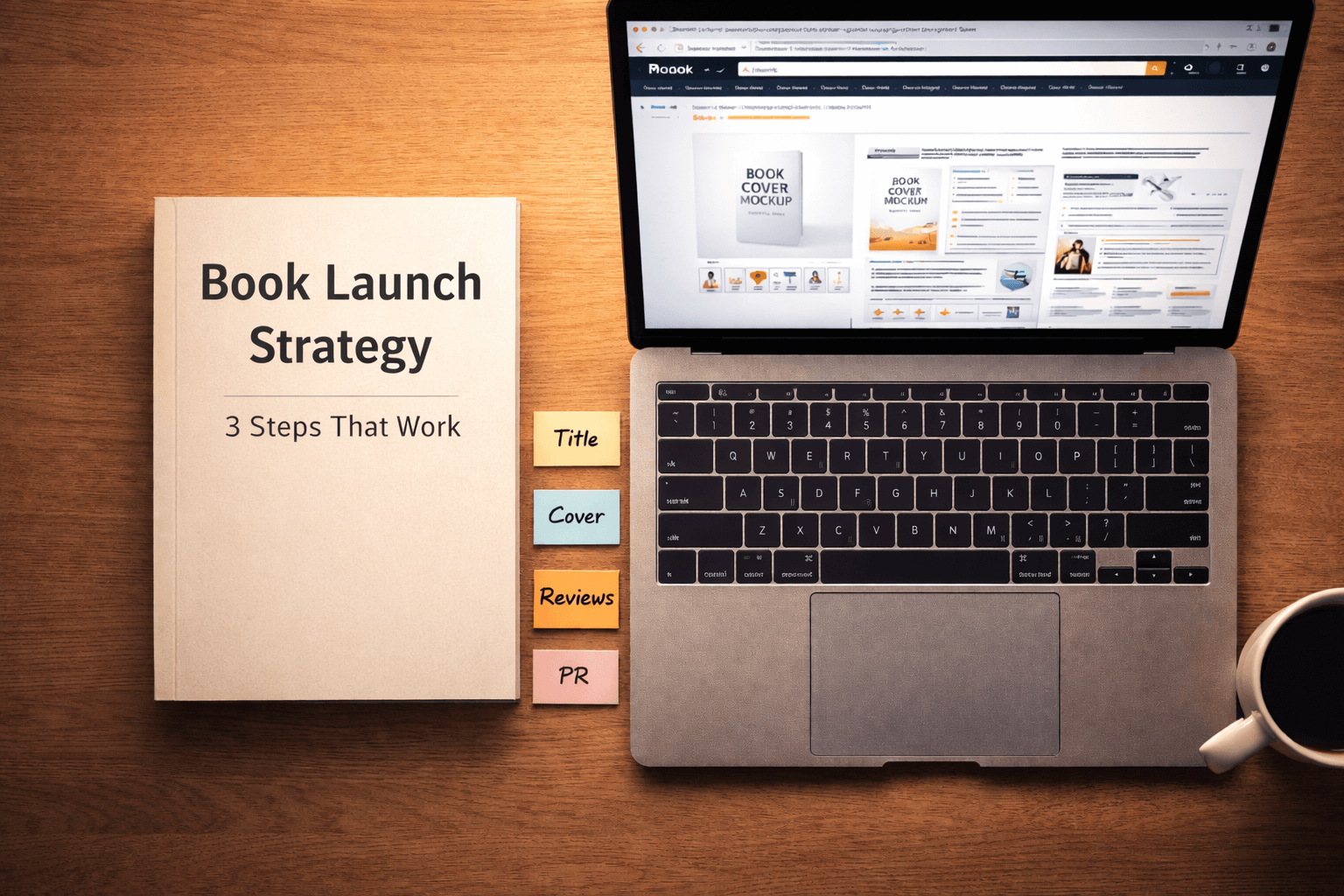

What is the best Amazon book launch strategy for new authors?
The most reliable Amazon book launch strategy has three parts, and each part builds momentum for the next. First, perfect your positioning with a tight title, clean cover, and robust A+ content. Second, run a short soft launch to secure 50 to 100 verified reviews. Third, execute a hard launch that combines press releases, targeted paid placements, and social campaigns.
Many authors hit publish and hope. We do the opposite. This strategy assumes you do not yet have a large audience, so it uses your book to build one. Below you will find the exact framework we teach our authors, including positioning guardrails, a review sprint, and a punchy hard launch plan that consistently drives category wins and long-tail sales.
Positioning: How do you choose a title and cover that convert?
Start with clarity and restraint. One to three words for the title is ideal, with a benefit-rich subtitle to finish the promise. Then keep the cover simple, avoid clutter, and ensure the typography carries the concept.
Short titles are pattern matched by buyers across categories, and they scan well in tiny Amazon thumbnails. Your subtitle should spell out outcomes, not features. Meanwhile, a clean, high-contrast cover outperforms busy designs because it signals confidence and makes the promise legible on mobile. If you are already an established face in your niche, a photo can help. If not, let the promise and concept lead on the front, and reserve your image for the back.
Quick title guidelines that hold up
- Main title: one to three words when possible; four is acceptable.
- Subtitle: one clear benefit or a tight set of three benefits.
- Mirror category language your ideal readers already use.
What belongs in the Amazon listing before you launch?
A complete listing includes a persuasive description, smart keywords, and rich A+ content modules with images and scannable copy blocks.
Treat your Amazon page like a landing page. The description should be skimmable with short paragraphs and benefit-forward subheads. Add A+ content to showcase visual proof, pull-quotes, comparison tiles, and a story-driven module that helps buyers visualize results. Most books do not use A+ at all, so even a basic set elevates your page and keeps shoppers from bouncing to “Customers also bought.”
Essential A+ modules to include
- Author story or credibility panel with a strong hook.
- Benefit tiles that map to your subtitle promises.
- Comparison chart that positions your book among alternatives.
- Callout image with a short testimonial or early praise.
Soft launch: Why target 50 to 100 verified reviews fast?
Because social proof reduces friction for buyers and signals momentum to Amazon. A page with 70 reviews will outsell a comparable page with seven.
Plan a two to three week sprint. Set your Kindle price to $0.99 during this window, then invite your warm network and aligned author groups to buy a copy and leave an honest review. Tell them they can read two or three chapters and review based on that, which makes follow-through more likely. Focus on verified reviews, since those carry more weight than reviews posted from gifted copies.
Soft launch checklist
- Price Kindle edition at $0.99 for the sprint.
- Send a simple ask with the purchase link and a one-paragraph prompt for what to look for.
- Track invites and follow ups. Assume only a quarter will review without nudges.
- Prioritize aligned author communities where you give first and ask second.
Hard launch: What activities move the sales needle most?
Use three levers in the same week, sequenced for reach and conversion. Publish three regionally targeted press releases, run paid placements on 20 to 40 genre-relevant sites, and stack social ads that drive to your Amazon page and your book funnel.
Press releases create fast, broad social proof and discoverability. Niche paid placements put your cover in front of buyers already primed for your topic. Social ads retarget interest and fill your owned list through your funnel, which ensures you keep customers for future books and offers. Together, these levers spike rankings, then the review base and A+ content help sustain sell-through.
Example hard launch calendar
- Monday: Press release 1, social ad set 1 live, first wave of paid placements.
- Wednesday: Press release 2, rotate creatives, second wave of paid placements.
- Friday: Press release 3, social ad set 2, short livestream or podcast guesting.

Should you run a book funnel alongside Amazon?
Yes. Drive some traffic to your own funnel to acquire customers directly while Amazon amplifies reach.
Amazon brings scale and credibility. Your funnel brings customer ownership, cross-sells, and lifetime value. Many of our authors use a free plus shipping or low-ticket digital offer, then present a discovery call or program pathway on the thank-you page. This parallel path compounds revenue and insulates you from platform changes.
How long should you keep the $0.99 price?
Keep the discount only during the soft launch. For the hard launch, raise to your planned retail to protect positioning and revenue.
The aim of the $0.99 window is verified reviews, not profit. Once the review base is in place, the higher price boosts perceived value and margin, especially as press and placements increase demand.
What if you are relaunching an older book?
Treat it like a fresh launch. Fix positioning first, upgrade the listing, then run the same soft and hard launch cadence.
Audit the title, cover, and subtitle. If the cover is busy or dated, refresh it. Rebuild the description and add A+ modules. Then run a new review sprint to lift recent activity before you execute your media and placement plan.
How do you choose categories and keywords?
Choose categories that are relevant and winnable, then map keywords to the language readers use on Amazon.
Relevance protects your listing and improves conversions. Winnability helps you rank during the spike. Build a short list of category targets and reader phrases that appear in top listings, reviews, and autosuggest. Use those terms naturally in your subtitle, description, and A+ copy.
What are the biggest publishing mistakes?
Rushing a launch without positioning, skipping A+ content, and accepting five to ten reviews as “enough.”
We see these three errors limit results even for strong manuscripts. Solve positioning first, invest a day in A+ modules, and sprint to 50 to 100 verified reviews before you ask paid traffic to convert. According to Best Seller Publishing, fixing these three items turns a quiet release into a bestseller-caliber launch for authors without a large audience.
FAQ: quick answers for busy authors
How many reviews do I really need?
Plan for 50 to 100 verified reviews during the soft launch. More is better, and verified reviews carry the most weight.
Should I give out free copies for reviews?
Gifted copies can produce reviews, however verified reviews from $0.99 purchases are more valuable. Prioritize verified.
Do press releases still help?
Yes. Three well-timed releases add authority, widen reach, and support ad performance during launch week.
When you line up these three parts, you stop hoping and start engineering demand. Position the book to convert. Build proof quickly. Then push hard with coordinated reach. This is the path we use daily with our authors.
Ready to Become a Published Author?
Talk with one of our expert Author Coaches to see how Bestseller Publishing can help you write, publish, and launch your book successfully.
Schedule Your Free Strategy Call