
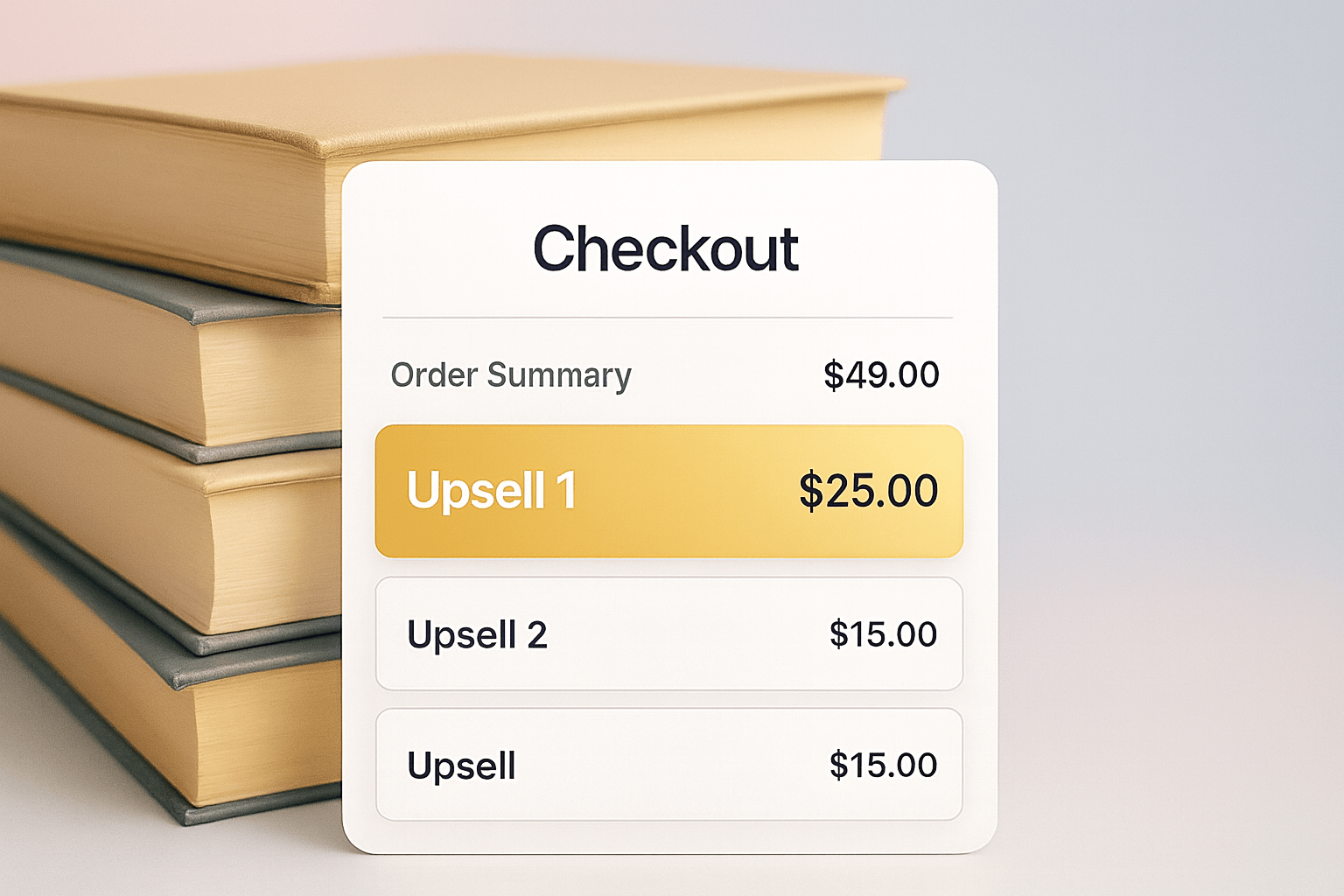

Start your book funnel upsell strategy with a realistic CPA baseline
Most markets settle near a triple digit acquisition cost as ad platforms mature. Beginning your book funnel upsell strategy with a 100 dollar CPA assumption keeps your model conservative and your offer stack ambitious. It prevents underbuilding, which is the primary reason funnels fail to liquidate at scale. Set this baseline first, then size your rule-of-five stack accordingly. When you beat the number, your margin expands. When costs rise, you are prepared.
As you roll out, measure by seven day cohorts. If you see consistent payback inside 14 to 30 days, you can increase spend without overfitting creatives to day-one ROAS. This mindset supports bestseller momentum, verified review velocity, and organic platform placement that reduces blended CAC over time.
Apply the rule of five to engineer average order value
Why it matters: The rule of five ensures sufficient revenue opportunity exists on the first visit. Without it, even great conversion rates cannot cover traffic costs reliably.
How to apply it: If your book is 9 to 19 dollars, add a 17 to 47 dollar order bump that accelerates implementation. Then present two upsells in the 97 to 297 dollar range. Combined, your maximum cartable value should be at least five times your CPA.
Proof: Authors who add meaningful implementation assets at the bump increase both take rate and satisfaction. Meanwhile, upsell one consistently delivers the largest AOV contribution when treated as a full offer with its own message and proof, not as a mere add-on.
Outcome: Hitting your five times threshold makes it possible to target 70 percent front end liquidation and keep scaling while cohorts mature.
Make upsell one the star of your book funnel upsell strategy
Why it matters: Upsell one is the highest visibility and the lowest friction step after checkout. Because drop off increases with each successive page, the first upsell is where you must concentrate the most value.
How to apply it: Build a 9 to 15 minute VSL that respects the buyer’s time. Reframe the outcome, present a shorter path, show the assets, and prove the transformation with one concise case. Price between 97 and 297 dollars unless your niche can bear more. Always include a no thanks link to preserve flow.
Proof: Compelling, uncommon angles improve take. Strong titles and emotional hooks are not just for books. They help upsells stand out and increase acceptance.
Outcome: When upsell one earns 20 percent or more of AOV, your cart math becomes resilient to CPM swings.

Add continuity early to stabilize cash flow
Why it matters: Recurring revenue makes your model predictable. It also supports higher allowable CAC because every new subscriber compounds monthly MRR.
How to apply it: Offer continuity as a guided implementation community with office hours, templates, and a short sprint plan for the first 30 days. Price it at 37 to 97 dollars monthly. Introduce it as upsell two or as a post-purchase offer in your welcome sequence.
Proof: Launches that combine verified reviews and visibility with a continuity offer often create a virtuous cycle of media, speaking, and inbound demand that feeds the top of the funnel.
Outcome: Continuity smooths month to month revenue and makes it easier to invest in experiments without risking cash crunches.
Optimize your title, cover, and description for retail platforms
Why it matters: Retail discovery engines reward clarity, quality, and social proof. Your title and description drive click and conversion, which feed their algorithms.
How to apply it: Choose a curiosity rich title, invest in a professional cover, and craft your description like ad copy. Use keywords and benefits. Drive verified reviews at paid price so the badges and ranking signals stick.
Proof: Curiosity forward titles and early verified reviews increase conversion and placement on category pages, which multiplies exposure and boosted sales. {index=15}
Outcome: Better surface signals reduce your blended CAC and help your entire funnel convert more efficiently.
Choose your payback window and guard your learning
Why it matters: If you demand day-one profit, you will shrink your audience and stall algorithmic learning. A disciplined payback window keeps your spend steady as creative and offer improvements compound.
How to apply it: Decide if your payback target is 7, 14, or 30 days. Align your nurture with that horizon. Use masterclasses or challenges to create buying moments and pull future revenue forward within the window.
Proof: Launch playbooks that prioritize attention, category ranking, and early review velocity create momentum that makes later ads cheaper and more effective.
Outcome: You scale further, learn faster, and avoid the feast or famine pattern common to purely day-one funnels.
Quick implementation checklist
- Assume 100 dollar CPA, then validate with spend.
- Map rule of five to guarantee at least 500 dollars of cartable value.
- Turn upsell one into a full offer with a focused VSL.
- Add continuity at 37 to 97 dollars with strong onboarding.
- Pick a 14 to 30 day payback window and hold steady.
- Invest in title, cover, verified reviews, and a keyword rich description.
Want help packaging your book and offers so every page does its job? Explore our programs and resources, or talk with an Author Coach about your specific goal. We have helped authors create attention, authority, and demand with a thoughtful conversion flow that respects the reader and rewards the business.
Ready to Become a Published Author?
Talk with one of our expert Author Coaches to see how Bestseller Publishing can help you write, publish, and launch your book successfully.
Schedule Your Free Strategy Call